|
|
Contact:
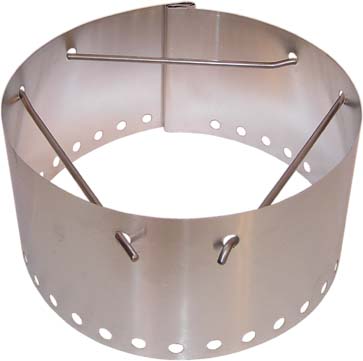
Pot stands are important if you have a simple pop can alcohol stove that doesn't have a stand built in, and may also be used to supplement or replace heavier and less stable pot supports on commercially manufactured stoves. The ideal stand for you depends on the size of your pot, personal preference and/or supplies on hand.

One popular theme is to combine a potstand with a windscreen designed specifically for your pot and stove setup. The advantage being that you have a single lightweight unit that insulates and securely cradles your pot. The windscreen can be made from aluminum roof flashing, cutouts from a thin aluminum bake pan, or just about any type of thin metal sheet (shim stock, heavy hobby foil, drink can sidewalls, etc.). Some backpackers use stainless steel shim or titanium foil to make durable and heat resistant pot stands and can double as wood stoves.
Step 1 Windscreen Trimming
The real first step in building a windscreen-potstand is to read through the rest of this page and determine exactly what type of design you would like to construct. After you have settled on a design, you can make a prototype out of paper extra foil and see how well this fits around your pot and stove and how well it packs.
Most designs fit around the pot in a similar manner and can be trimmed to size using the simple diagrams below (the folded and cone shaped versions are obvious exceptions). First, measure the outside diameter of the pot you wish to use, keeping in mind that the top rim might be larger than the rest of the pot. You may want to just measure the inner diameter of the pot if there is a large lip and your windscreen isn't going all the way to the top of your pot.
Add 1-2 cm (1/4 to 3/4 of an inch) to the diameter of your pot to allow for some space around your pot (necessary for carbon dioxide ventilation).
Multiply the diameter of your pot stand by 3.14 (Pi) and add 7.5 cm or about 3 inches for your locking tabs (if using the double folded locking ends). This will be the overal length your your windscreen prior to folding.
Now determine the height of your windscreen. Ideally, the windscreen should come up as high around the pot as possible, while still allowing room for handles, pot lifters, or to grab with protected hands. Determine how much of your pot you would like to cover and add the height of your stove plus about 2.5cm for the flame. If you wish to store your windscreen in your pot, your height will simply be the depth of you pot.
Mark your measurements on a piece of sheet metal (aluminum flashing or bake pan). Taping graph paper on your sheet will help make square measurements and straight cuts a snap.
X = desired space between pot and windscreen (1-2cm)
Y = space between stove and pot (2.5-5cm)
If you are using aluminum flashing or some other sheet metal with a coating, you may wish to sand them down to remove any coating that will blacken, burn and become sticky after you fire up your stove.
The following pot stand calculator should help with designing. The Fiddle Factor feature gives just a little bit of length to your screen to make up for any short cuts, folds, etc.
Step 2 Connecting the Ends
Backpackers often store their windscreen-potstands in their pot, around/inside a sleep pad, wrapped around their fuel bottle or rolled up for protection. Because of this, it is helpful (if not required) to be able to disassemble your windscreen for storage. Luckily there are several methods for making assembling and disassembling possible.
Your connecting technique will determine how much extra screen material you will need to overlap or lock your ends. You should have read this prior to trimming your screen to help plan how much overlap you need - but if you have already made your cut, you should be fine since the above template allows for enough overlap for any of the following techniques.
| Style | Overlap Need |
| 1.5cm Double Rolled Locking Ends | 7.5cm |
| 1.5cm Single Hooked Ends | 4.5cm |
| Paperclipped Ends | 2cm+ |
| Paperclipped and Punched Ends | 2cm+ |
| 3cm Buckle | >3cm |
| Locking Slit Ends | 2cm+ |
Double Rolled Locking Ends. This is one of the sturdier methods for locking your pot stand in position. Roll/fold the edges of your stand as shown below. A nail or ink tube from a disposable ballpoint pen can be used to keep a nice rounded edge - simply place it inside your folds and squeeze with your fingers. Rolled edges, compared to flat ones, will help the two ends lock together. It may be a bit tricky to get that perfect fold to work just right, but it should remold itself after your first test with a lit stove.
Note - If you are using coated aluminum sheet (such as aluminum roof flashing) you may want to at the very least sand down where the edges will come in contact. This will prevent the ends from getting stuck together after the pot stand is heated up, causing the coating to burns, melt and become sticky.
For a 1.5cm hook, you will need to add 7.5cm to the length of your windscreen (as shown in the example above).
Image Not to Scale
Hooked Ends. This is not the sturdiest method of connecting the ends, but is simple to do. Try to get the very end of the hook to press against the windscreen without putting a crease in the fold.
For a 1.5cm hook, you will need to add 4.5cm to the length of your windscreen (3cm less than the example above).
Image Not to Scale
Paperclipped Ends. Paperclips or binder clips do a great job of holding windscreens together.
For a small paperclip, you will need to add about 2cm or more to the length of your windscreen (5.5cm less than the example above). The paperclip method allows you a lot of flexibility in sizing your windscreen. Some backpackers even adjust the size of their screens to adjust heat output and performance of their stoves.
Image Not to Scale
Paperclipped and Punched Ends. This is sturdier than just paperclipping.
For a small paperclip, you will need to add about 2cm or more to the length of your windscreen if you center your hole 1cm from the end (5.5cm less than the example above).
Image Not to Scale
Tabbed Ends. Not the most durable setup and the tabs may hook on things, and eventually beak off. Try to get the very end of the tabs to press against the windscreen without putting a crease in the fold, since a crease can lead to a tear.
You will need to add about 2cm to the length of your windscreen if you center your tab 1cm from the end (5.5cm less than the example above). This tab allows you to slide in the other end of the windscreen and allows for adjustability.
Image Not to Scale
Belt Buckle. Jason Klass has made a very simple attachment system that allows you to easily resize your windscreen/potstand diameter to fit different size pots and to become small enough to stow inside a cook pot. The sliding band design can be applied to any windscreen made out of aluminum flashing and holds better than paperclips. Simply cut a separate length of sheet metal and fold over the ends so that it cradles the windscreen/potstand and allows the two ends to slide through it. Try to get the ends of the buckle to press against the windscreen without putting a crease in the fold, since a crease can lead to a tear.
Here are some examples of his design:
Jason Klass' Belt Buckle Windscreen
Old images:
Jason Klass' Newest Belt Buckle Windscreen
Jason Klass' Updated Belt Buckle Windscreen
Jason Klass' Belt Buckle Windsreen
Image Not to Scale
Punched Ends. This is not the best way to connect or seal the ends. If you are using metal rods for pot supports, you may punch holes right at the edge and use the rod to keep the holes lined up.
You will need to add about 2cm to the length of your windscreen if you center your hole 1cm from the end (5.5cm less than the example above) and more if you desire a more stable setup.
Image Not to Scale
Locking Slit Ends. This is not the best way to connect or seal the ends, and you may eventually hook your end on some gear and damage your stand. Make a slit just past half way down the side of each end of your wind screen and lock them together for use.
You will need to add about 2cm to the length of your windscreen if you center your slit 1cm from the end (5.5cm less than the example above).
Image Not to Scale
Permanently Locked Ends. If you don't need to disassemble your windscreen for storage (such as when you can flip it over and slide it over your pot or when it is small enough to place it in your pot as is), you can permanently lock the ends with rivets, a pressed seam or folded over tabs. You might even be able to find an acceptably sized aluminum duct or tin can already made for your application.
Step 3 Pot Supports
There are several different methods of supporting you pot with your windscreen. Here are a few examples:
Narrow Windscreen. Just build you windscreen so that it's closed diameter is less than that of your pot and set your pot directly on it. You will need to ensure that you have enough ventilation at the top and bottom of your stand for fresh air to enter and gases from combustion can escape. This can be done by punching out holes with a hole punch or by simply cutting out several "V" notches. This setup doesn't insulate the pot as well as other setups that have taller windscreens that engulf the pot. The height of this windscreen setup should be around the height of your stove plus about 2.5cm (depending on design).
Since this stand design must be smaller than your pot to work, you can permanently rivet the stand together for strength and still store it in your pot.
Note: if you make an aluminum stand so narrow that flames are in contact with the stand - your stand will eventually fail from the heat.
Notable versions:
Sgt Rock's Home Made Trioxane Stove
Eckert's Ultralight Trangia Pot Stand
Double Rods. Punch out four holes at about the height of your stove plus 2.5cm and slide two metal rods through them. If don't have a hole punch long enough, you can use a Unibit, hammer and punch, or sandwich your sheet with blocks of wood and drill.

As far as what to use for a metal rod, you have many options:
steel, titanium or thick aluminum tent stakes will work
coat hangers work, but they may become brittle over time and fail when you need them most
stainless bicycle spokes don't rust and can be recycled from old wheels (use a magnet to make sure they aren't aluminum)
small gauge stainless steel rods are nice and titanium is even better
brass and aluminum rods may not work with the high heat from your stove
in lieu of one of your steel rods you can cut a notch in your wind screen and rest the pot handle on it to hold up that end of the pot
Notable versions:
C.D. Pritchard's Pop Can Stove
Building a better POPCAN Stove (pt.II)
CASEYandEMILY.com - Pot Stand/Windscreen for Soda Can Stove
Note - 15 gauge bicycle spokes are 1.8mm in diameter while 14 gauge spokes are 2.0mm in diameter.
The following Two Rod Windscreen Potstand Calculator should help make designing much easier.
Triple Rods. Three is the magic number for stability and you may be able to use narrower rods than with a double rod setup, which may be easier to fit in your pot. Punch out six holes at about the height of your stove plus 2.5cm and slide three metal rods through them. If don't have a hole punch long enough, you can use a Unibit, hammer and punch, or sandwich your sheet with blocks of wood and drill.

As far as what to use for a metal rod, you have many options:
steel, titanium or thick aluminum tent stakes will work
coat hangers work, but they may become brittle over time and fail when you need them most
stainless bicycle spokes don't rust and can be recycled from old wheels (use a magnet to make sure they aren't aluminum)
small gauge stainless steel rods are nice and titanium is even better
brass and aluminum rods may not work with the high heat from your stove
in lieu of one of your steel rods you can cut a notch in your wind screen and rest the pot handle on it to hold up that end of the pot
Notable version:
Note - 15 gauge bicycle spokes are 1.8mm in diameter while 14 gauge spokes are 2.0mm in diameter.
The following Three Rod Windscreen Potstand Calculator should help make designing much easier.
One Piece Folded. You can fold in tabs to build platforms for your pot like the one designed by a stover who calls himself StoveStomper. If you are using aluminum sheet for your windscreen you may not want to use this design for narrow pots as the folded in tabs may be damaged by the heat of your stove. Very thin aluminum, such as from disposable bake pans, isn't recommended for this setup - especially for narrow pots. Add 12cms to the length of the dimensions above to allow for three 2cm long tabs (for a tight fitting windscreen) or 18cm for 3cm tabs (as shown below).

Supports can be held together with rivets, staples, wishful thinking or folded over tabs.
Notable versions:
StoveStomper's 1.0oz Ultralight Backpacking Solid Fuel Stove/Windscreen
StoveStomper's New .0oz Ultralight Backpacking Solid Fuel Stove/Windscreen
* "StoveStomper" is somewhat of a interesting fellow. Although his postings do not seem to be available on the web any longer, he seems to be the first person to publish this type of pot stand design on the web.
The following Folded Windscreen Potstand Calculator should help make designing much easier.
Riveted tabs. You may not want to use this design for narrow pots as it might be lighter and more stable to use a design with short metal rods.
Cut out three pieces of aluminum flashing 10cm by 6cm (or as tall as your stove height plus 2.5cm). These will become the pieces that hold up your pot.
Note: Constructing tabs so that the bottom of each tab extends all the way to the ground will provide better support than the version shown. In fact, for a little bit of extra weight, you can use sections of aluminum angle iron that extend to the base of the stand for dependable and durable support.
Mark and fold them as shown below. You may have to lengthen or shorten these measurements depending on the size of your stove and pot.
Round off all corners and sand all edges smooth.
Now temporarily tape or krazy glue these tabs unto your main piece. Rivets work best, but you can possibly use a heavy duty staples.
The T Template might help if you like templates.
Rivets can be trimmed with scissors and smoothed down with sandpaper and/or a file.
X = desired space between pot and windscreen (1-2cm)
Y = space between stove and pot (2.5-5cm)
If you like, you can add a threaded rivet or nut to your pot stand to store a backup screw for your pressurized jet stove.
The following Rivited Windscreen Potstand Calculator should help make designing much easier.
Step 4 Final Touches
Ventilation
If you haven't done so already, tape a couple of lengths of graph paper to your stand to help keep your ventilation holes evenly spaced. Now, punch out one to two rows of holes just above the bottom border to allow air to enter. Some backpackers prefer to punch out holes only on one side of the stove so these openings can be pointed away from the wind.
X = desired space between pot and windscreen (1-2cm)
Y = space between stove and pot (2.5-5cm)
Remove the paper.
Clip the stand together and test your stove and pot. Adjust or start over as required.
Smoothing
Round off all corners and use an SOS pad to smooth down all edges to prevent future cuts in the outback.
Lengthening Windscreens
You may want a taller windscreen than one that you can fit in your pot. How can you do this?
if you want a taller pot stand, you can stack two of them.
make a slightly narrower windscreen and set it on the pot supports of the other screen.
cut the bottom pot stand piece to the height of where you would like to set your pot and punch your rod holes at the base of the top piece - insert your steel wires through the top piece and set the top piece on the bottom piece with the steel wires supported by the bottom piece (the bottom of the top piece under the steel rod can wrap around the outside or inside of the bottom half).
punch three holes in the base of the top piece and use paperclips to clasp it to the top of the bottom piece.
Make tabs or notches that allow the two sections to interconnect.
taller pot stands can also be made and rolled up in a sleeping mat or into a very tight cylinder (for strength and compactness).
use a separate windscreen made form foldable foil and keep is simple.
Notable versions:
The goal is to find a lightweight method for your setup that supports your pot somewhere near 2.5-4cm or 1-1.5 inches (varies with setup) above your stove.
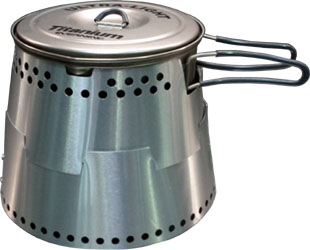
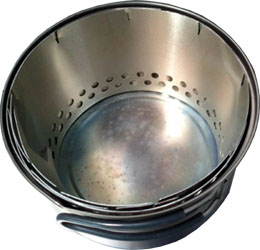
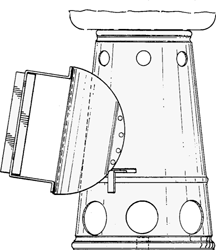
Cone Stand (aka Frustum Potstand) - This is can be more difficult to pack and build the other potstand designs, but when built properly, it provides a sturdy base as well as a choke that traps heat around the bottom and sides of your pot. This is particularly useful for tall narrow pots - such as can pots.

You may use rods, folds or other tricks to hold up your pot. If you have a pot with an outside rim, you may be able to set this rim directly on the upper edge of the pot stand as shown above.

Titanium Goat Pot Stand in Wood Stove configuration
If you make your screen out of steel (stainless preferred) or titanium, you can make a screen that doubles as a wood/biomass stove. Note how the commercial Titanium Goat stand above can use tent stakes to hold the pot up high and allow enough room inside the pot stand for a protected wood fire, and if the stakes are removed, the pot can sit much lower with the top of the stand snuggly wrapped around the underside of the pot's outer rim.
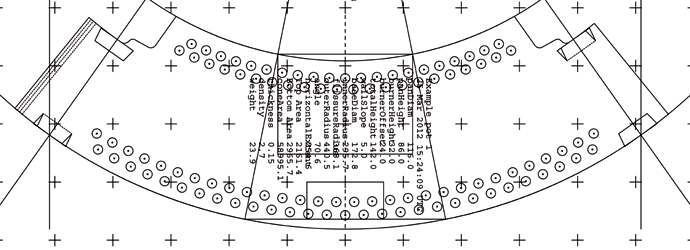
A cone shaped pot stand can be a bit tricky to build, but a little bit of math, a few careful measurements and a little bit of design planning - it becomes quite doable. You will need to carefully measure your pots outer diameter and determine the base diameter and how high you want your stand to sit. Halve your two diameter measurements and you have your R1, R2 and H numbers.

With these numbers, you can calculate your T angle and your S1 and S2 lengths buy using the following formulas or this Cone/Frustum Windscreen Potstand Calculator.
Use a piece of paper to draw out the shape of your cone and remember to add a little to the ends to allow for overlapping. You can use a string, ruler, etc to measure out the S1 and (S1 - S2) lengths and use them to measure out the two arcs by pivoting them on the apex of the T angle. Cut the paper sheet to size and see if it comes together and creates your desired shape. If not, make your adjustments or start over with new measurements.
Once you are happy with your shape, you can use your paper trial as a template to cut out your actual pot stand.
Rocks - The simplest method is to find a couple of rocks the right height. If you decide to pack your rocks, pumice seems to be one of the lightest options (but not the most durable). You can also drill holes in your rock to lighten your load but most hikers plan on finding suitable rocks on the trail.
Folded Wire - Coat hangers and stainless steel or titanium rods (stainless bicycle spokes) can be bent into all kinds of shapes.
Note - coat hangers may become brittle over time and fail when you need them most
Notable versions:
LaMar Kirby's classic hanger stand
Make Your Own Gear: The “Z-Stand” Pot Support for Alcohol Stoves - requires logon
Note - 15 gauge bicycle spokes are 1.8mm in diameter while 14 gauge spokes are 2.0mm in diameter.
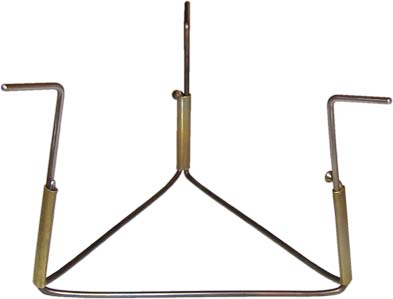
Collapsible Wire Tripods - Coat hangers and stainless steel or titanium rods (stainless bicycle spokes) can be bent and held together with metal tubing to create collapsible tripod pot stands.
Note - coat hangers may become brittle over time and fail when you need them most
Notable versions:
Foldable titanium bicycle spoke stand by Deems Burton
Dominique Stender's Dosenkocher (German) Babel Fish
Gossamergear's Fire-Fly Stove

Short version of Deems Burton's Tripod
15GA spokes and 5/32" brass tubing
Note - 15 gauge bicycle spokes are 1.8mm in diameter while 14 gauge spokes are 2.0mm in diameter.
Tent Stakes - You can stick three or more steel or titanium tent stakes in the ground. Steel bicycle spokes might also be sturdy enough for your setup. Note - Aluminum and brass aren't recommended as they may not be able to support a full pot at high temperatures.
Notable versions:
Welded Wire - Hardware cloth, gutter strainers and expanded sheet can be trimmed and bent into all kinds of shapes. Stainless steel welded wire is solid, feels nice, doesn't rust and isn't poisonous when heated. Try McMaster-Carr if you can't find what you are looking for at the local hardware or metal shop.
To save weight, you can trim out unneeded sections between necessary supports. Note - avoid using galvanized steel materials for your pot stand as it will release poisonous gases when heated.
Other versions of this setup include setting a stand inside or on top of your stove, depending on your stove design.
Notable versions:
Stand used by Don Johnston's Photon Stove
Roy L. "TrailDad" Robinson's Cat Food Can Alcohol Stove
HogOnIce's Homemade 3.7 oz. Cooking System
Terry M. Trier's Dual-Fuel Backpacking Stove
Sue & Rich Freeman Lightweight Backpacking Stove Option
Terry M. Trier's Simple Esbit Stove for Backpacking
Cans - Trimmed down and ventilated tin cans (such as coffee cans). These may also double as wood burners.

C-ration can
If you find a can the perfect height for your application, you can simply cut out the top and add some vent holes in the side of the can. Big holes may work best, but you can also just use a church key to make several holes all around the top and bottom edge of the can.
Notable versions:
Trailquest's One Ounce Pot Support
Anthony Dunk's light-weight pot stand for Trangia Stoves
Michael Connick's Homemade Three-Fuel Stove
Building a better POPCAN Stove
Michael Koussiafes' Solid Fuel Stove

Small Coffee Can
Collapsible - Flat sections of sheet metal can be fitted together and later disassembled for storage. Larger ones can also double as wood stoves.
Notable versions:
Nimblewill Nomad's Wood Burning Stove
Trangia Westwind Stove
OD BOX ホームページ and ODBOXオリジナル

SideBurner Stoves - You can even set your pot on your stove if you set it up with jets on the side.
Notable versions:
Low Pressure SideBurner Alcohol Stoves

Walk down the aisles of your local hardware store and try fitting things around your stove and under your pot. Just remember to avoid galvanized steel as it releases toxic gasses when heated and can cause heavy metal poisoning.
This allows you to set a Type I Can-Pot directly on your stove without the need of a pot stand.
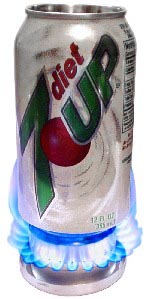
Construction -
Simply cut out a rectangular piece of can sidewall or aluminum flashing to about the same length as your inner tube (the max length from a 12oz can sidewall would be ideal) and about 1-2mm wider.
Roll it up and stick it in your stove.
Test placing your Can-Pot on your stove and trim as necessary.
You can cut locking slits in your adapter to strengthen it but it must be perfectly set up and you'll end up with more sharp corners than you had before (unless you epoxy them down or round them off). Epoxying it into a solid cylinder, punching three weep holes on the bottom edge, and/or sealing it to the stove with JB weld or RTV are also optional but not required.

The Type I Can-Pot made from a 12oz can may not fit tightly on a stove made of 6oz cans with the adapter above, but the adapter should hold the pot enough that it won't fall off while boiling. Play with it until you are comfortable enough to take it backpacking, as it doesn't look like a good idea at first, but it does work.
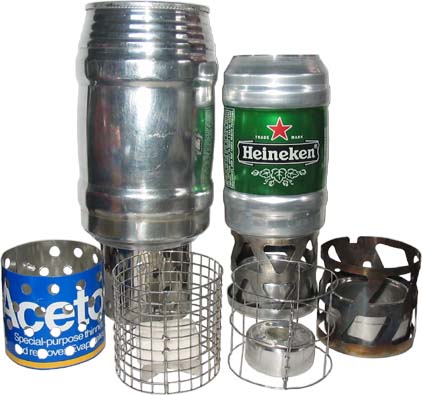
If you wish to use a 24oz Type I Can-Pot (such as a large Heineken can) with a larger diameter bottom depression, you can simply cut out a disc (see templates) from aluminum flashing or steel shim and force/set it into the depression. Another option is to cut out the bottom of a 3oz Spam Spread can and use it like the disc, which will fit perfectly. Either option will create a flat surface that will allow you to use a sideburner stove made from 12oz and 6oz cans. You may try to glue the adapter into the bottom of your Can-Pot if you like or just consider flipping the can over and making an inverted Type II Can-Pot instead.
If you want to get fancy, you can cut out the bottom of a 7oz Sterno can and fit it over the bottom of a Heineken can to make a nice flat surface. Or, you can use some pegs and a hammer to flatten out the bottom depression (it would be so much easier to cut the bottom of the can off and flip it over).

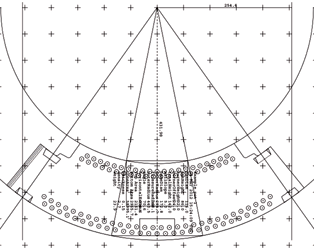
If you are using solid fuel tabs to cook with or wish to have something more stable and efficient than a Can-Pot Adapter, you can make a simple stand from a sheet of steel. A suitable sheet can be found in hobby stores (Easy Solder Tin), specialty metal stores (0.005 to 0.010 steel or stainless shim stock) or from an empty denatured alcohol can sidewall. Simply tape your template onto your sheet, punch out the holes (you will need a heavy duty punch, arch punch or drill), cut it out, test fit (can bottoms very from can to can), drill the rivet holes (unless you opt to use the tabs), roll in the overlapping edge just a bit for athletics, and rivet shut. Welded wire (don't use galvanized wire because of heavy metal poisoning) can be substituted for sheet metal but isn't as solid and will have many sharp edges that that should be filed down if you wish to avoid future cuts on you and/or your gear while out on the trail.

There are two different sized stands provided on the templates page. The smaller one design is only suitable for use with Can-Pots made from 12oz and 8oz cans. Due to its narrow diameter, you will be restricted to using solid fuel tabs, candles and alcohol stoves the size of tealights. And if you get creative, you can convert your stand into a stove.

A stand with a larger diameter is required for use with 24oz Heineken and Fosters Can-Pots and also works well with ones made of 12oz and 8oz cans and regular pots. These larger stands are wide enough to fit an alcohol topburner mini-stove made from 6oz cans (top and bottom section 20mm tall and inner wall 30mm) if you use short rivets, file them down or just use fold over tabs in lieu of rivets. A nice fitting base for the large Can-Pot stand can be made from a bottom of 3oz can of cat food.

|
Weights for large Can-Pot Stand |
||
|
|
oz |
gm |
|
Side of solvent can (0.012") |
0.7 |
19 |
|
0.010" steel shim |
0.6 |
18 |
|
Easy Solder Tin (0.009") |
0.6 |
16 |
|
Stainless Steel Welded Wire (0.032") 1/4" Mesh (4x4) - 9x28 squares |
0.5 |
13 |
|
0.005" stainless shim with rivets |
0.4 |
10 |
|
0.005" stainless shim without rivets |
0.4 |
10 |
|
Trimmed Stainless Steel Welded Wire (0.032") 1/2" Mesh (2x2) - 4x14 squares + one 1/4" row |
0.3 |
8 |
|
0.003" stainless shim without rivets "Opened" 3 holes connected |
0.3 |
7 |
|
0.005" stainless shim without rivets (seems flimsy but surprisingly resilient) |
0.2 |
6 |
|
aluminum flashing (questionable heat resistance - not recommended) |
0.2 |
6 |
|
Trimmed Stainless Steel Welded Wire (0.032") 1" Mesh (1x1) - 2x7 squares |
0.1 |
4 |
|
0.003" stainless shim without rivets "Opened" 4 holes connected |
0.1 |
4 |
|
"Opened" 0.005" stainless shim 3 holes connected |
"Opened" 0.003" stainless shim 4 holes connected |
Note for Alcohol stove use - You may need more ventilation in your stand if you are using an alcohol stove. Either "open" up your stand by removing metal from between some of the holes or use welded stainless wire (not galvanized).

Trimmed Stainless Steel Welded Wire (0.032") with 3 out of 4 wires removed
Welded wire isn't as resilient as sheet metal and you may want to soldering, weld or tie the ends together so that it doesn't collapse when a Can-Pot is placed on it. You can also trim off a considerable percentage of weight by removing extra supports from the welded wire. To avoid creating possibly hundreds of wire remnants with sharp points, instead of using wire snips, break the welds by grabbing the wire to be removed at the weld and twisting back and forth until the weld pops.
Since a great deal of heat is lost going out past the narrow bottom of the Can-Pot, a more efficient alcohol system might be constructed by decreasing the heat output and redirecting the flames to concentrate at the bottom center of the pot. You might want to consider using a Tealight Stove. Another option is to make a pressurized mini stove (top and bottom section 20mm tall with/without a 30mm inner wall) with its jets positioned around the inner ring of the stove angled in at 45°. A primer pan made form a 3oz cat food can should allow a large Can-Pot stand and mini stove to fit snugly on it. Twenty-four holes with a #71 drill puts out way too much heat.

Mini Pressurized Stove with all its jets focused at one central point
If you want to use the 24oz Heineken can or a Fosters can as a pot, you can make a stove designed specifically for that.

|
The main portion of this stove is made from a 3oz Hormel Spam Spread can. It has been left mostly intact, with a fuel port hole cut in the bottom and jets drilled in the side.
Inner cylinder is 19mm wide.
28 holes 15mm from top of the stove drilled with #71 drill (needle size).
Heineken can bottoms fit perfectly around the rim and regular pots and pans can be placed on top of stove.
For details see - Zen Stove and Simplified Zen Stove. |
|

Top portion of stove is a top from a Guinness can with the inner most circular crease scored and cut out. Epoxied and centered is a circular ridge from the bottom of a Coke can (center depression cut out and everything below bottom of outside ridge cut away). 30mm tall.
Inner cylinder is 40mm wide
Bottom is an unstretched Pepsi can (fits snugly over top part) 20mm tall.
24 holes 15mm from top of can drilled with #57 drill (pushpin size). Note - if you want more heat output, you may want to drill your holes just a bit more than 15mm from the top of your can.
The Guinness can is noticeably thicker than regular 12oz cans and should add weight and presumably strength to your stove (especially if you use the side wall for the inner chamber wall).
Heineken can bottoms fit perfectly around the rim and most 12oz can bottoms fit inside the rim. Pots and pans can be placed on top of stove. |
|
|
Very important - J-B weld is not a suitable epoxy for epoxying the top adapter and will burn off after the fist couple of uses.
Top portion is a rim from an Albertson's Root Beer can (rim has about the same dimensions as a Guinness top) with the innermost circular crease scored (from inside of can with a knife) and removed. The side of can was scored at its highest point and removed. This is epoxied to the top of the stove and carefully centered.
Stove made from two 6oz V-8 cans. 30mm top and 20mm bottom. Bottom was stretched over two cans (a tool made of one unopened can with an empty can stretched over it).
Inner cylinder is 40mm wide.
The unnecessary stove base is a bottom from a Coke can (ridge cut off with stove slipped tightly in hole) epoxied to the side of stove. This adds some stability, weight and bulk to the stove.
Like its big brother, Heineken can bottoms fit perfectly around the rim and most 12oz can bottoms fit inside the rim. Pots and pans can be placed on top of stove. |
|
When all is done, you should have a 1oz cook system (2oz if you use the 24oz Heineken can).
Please feel free to link to this site so that others can find it. It's easy to link to this site - simply copy the text below onto your web page or see How to Link To Zen Stoves for other linking options.