|
|
|
|
Contact:
![zenseeker [at] hotmail [dot] com](EmailImage.gif)
Homemade wood stoves can be as simple as setting up a windscreen and burning the wood inside it (pot set on stakes or rocks). More complex versions are elevated off the ground to protect your fire and ground, incorporate integrated pot stands and sometimes even have electric fans.
There are several commercial and many more homemade wood stoves out on the trail and the advantages are obvious.
Advantages include:
generally weigh a bit more than other stoves but since you don't have to carry fuel this system may be lighter than other systems for long trips
able to melt enormous amounts of snow without carrying huge amounts of fuel
cheap to make, free fuel
potential for unlimited hot water and even water purification
smoke may get rid or decrease the amount of bugs in your campsite
use as a heater to warm up cold bones on chilly evenings and brisk mornings
produce less overall pollution than other fuels (no drilling, refining, transporting, etc)
renewable energy source
a wood fire is magical
Disadvantages include:
weight, bulk
blackening of pots and everything your pot and stove touches in your pack
everything you hike with will smell like smoke
need to hunt for fuel at the end of the day or during your trek
dependence on availability of dry burnable wood
slow cook time
need to fiddle with the fire
knowledge of fire building required
potential to start forest fire in dry windy areas
may be banned in your hike area
Why is using a stove better than just starting a fire on bare earth? Wood stoves generally reflect a great deal of the heat back into the fire and protect the fire and fuel from wet and/or cold earth. The sides of the stove will protect your fire from wind while allowing for sufficient ventilation to support a more complete burn with less smoke. All of this keeps your fuel hot, increases gasification, and promotes a more efficient burn. As a result, you will need a fraction of the wood to cook up a meal in a stove compared to an open fire.
A well designed stove will also allow you to easily set a pot at a reasonable height over your flame. Not only is it easier to set your pot on a stove compared to an open fire, the heat and exhaust of a stove is usually funneled straight up towards the bottom of your pot.
Wood stoves may also be allowed where campfire aren't and can be environmentally friendly in that they don't use up as much of the forest for fuel, produce as much smoke as a campfire and if purposefully built, will not even burn the ground they are on (leave no trace).
Zip Stoves/Turbo Stoves
A zip or turbo stove is a wood stove which allows you to force fresh air into your stove. This is often done with an electric fan, but you can also use a blow hose, hand/foot pump or bellow. This added air and really speed up the burn of your fuel and increase fuel efficiency, allowing you to cook more with less fuel.

10oz Sierra Titanium Stove
ZZ manufacturing makes the well know Sierra Zip Ztove which is a self contained wood stove with a battery operated fan to keep the fire going. The original steel versioni of this weights over a pound without the weight of the battery (AA or D cell) which makes it seem heavy compared to other backpacking stoves. This can be offset by the weight of fuel which you don't need to carry on longer trips and to coolness of this stove. There are a number of ways to improve and/or lighten the steel version of the stove (see Links) and a 10 ounce titanium version is also available. It is also relatively easy to add a solar cell to recharge batteries and help power the fan during the day.
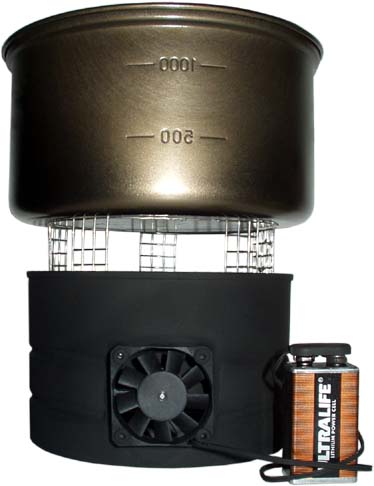
5.4oz Stove (including pot stand)
Homemade versions of this stove can be made from various sized tin cans, pots or sheet metal (such as aluminum flashing) and an electric fan (computer fans work well) with a power source. Air output to the stove can be controlled by adding variable resistors to your electrical circuit or by just moving an unattached fan further away from the stove opening. The stove shown above uses and inner wall made from a steel can which contains the fire, helps distribute the forced air flow and insulates the fan from the heat of your fire.
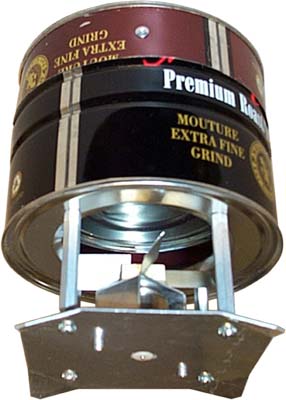
Building your stove so that it is off the ground and placing the fan centered underneath it provides more equal distribution of forced air and protects the ground.
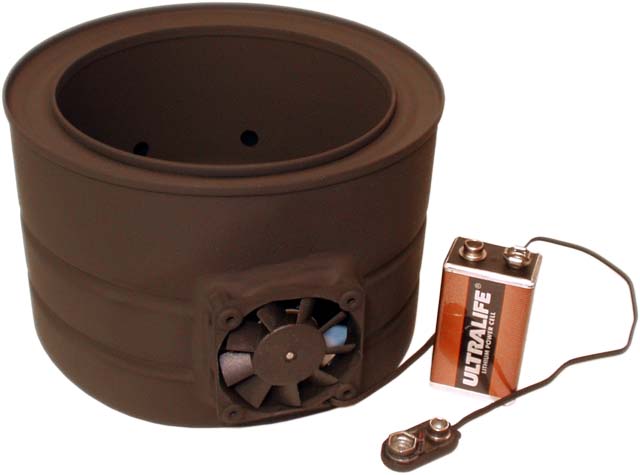
Made from 12oz Chicken and 26oz Decaf cans
Alternately, placing the fan on the side of the stove enables you to build a less complex stove without a bottom which should be easier to build, harder to break, harder to tip over and lighter.
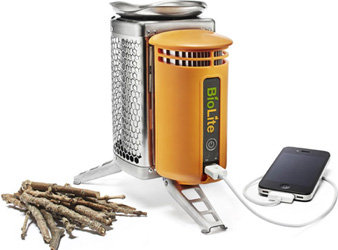
BioLite Thermoelectric Stove
Various versions of the BioLte use thermoelectric generators which powers a fan on the side of the stove and can also produces enough spare electricity to charge your electric gadgets. The BioLite CampStove weighs in at 33 oz (935 grams)
Similar stoves include:
Making Your own pulsed air wood stove
Web Archive - woodgas-stove.com Prior to 2013 offered a nice looking stove
Kettle/Chimney/Volcano Stoves
|
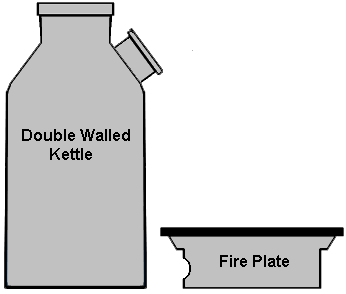
Chimney Kettle Parts |
|
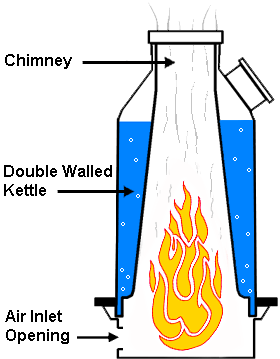
Chimney Kettle Setup |
Chimney water heaters have been around for a long time. The Russians have their Samovar and the Irish, Brits and Aussies all have similar kettle designs. These incorporate a chimney that built into the middle of and out the top the kettle. The kettle is set on a fire plate/bowl and when the fire gets going, hot air rises up the chimney and out the top of the kettle - forcing fresh air to be drawn into air inlet opening at the bottom of the fire pit, feeding the fire and keeping the flames relatively hot. These are generally made of brass, tin or aluminum and depending on how they are sealed (welded/brazed, riveted, rolled, epoxied, good/bad quality, etc), determines if and how much they will leak.
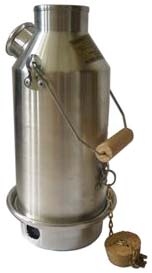
19.2oz Kelly Kettle
Homemade versions of the chimney kettle are possible, but difficult. There are a number of ways to setup the inner and outer walls of a kettle, but getting them to seal can be challenging. High temp epoxies such as JB weld are not suitable for contact with flames and not be non toxic. TIG welding allows for a solid heavy metal and toxin free seal for the DIYer taking on this challenge, but of course, this take a bit of skill and the right equipment. Brazing/soldering allows for an easier seal, but can coat your kettle with some less than desirable metals. One should avoid rods with lead in them as this will likely leach into your boiling water and is toxic.
Collapsible Wood Stoves
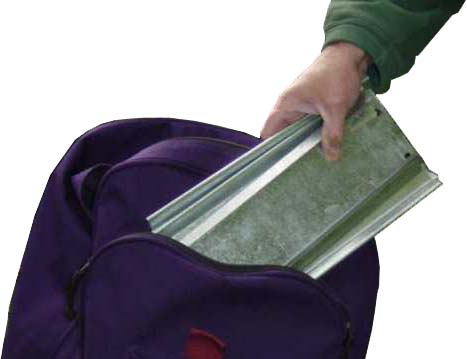
Disassembled Fire-Spout 100
Collapsible wood burning stoves allow you to easily dismantle, flatten and pack away what would otherwise be a very bulky setup.
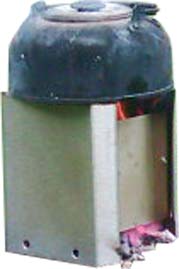
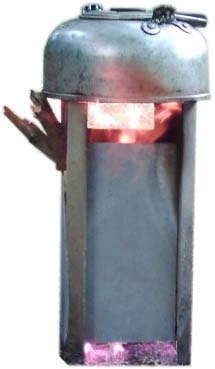
18oz Stainless Fire-Spout-Mini and 32oz Galvanized Fire-Spout 100
O.C.Outdoor's Fire-Spout is one of the few truly collapsible commercial wood burning stoves on the market.
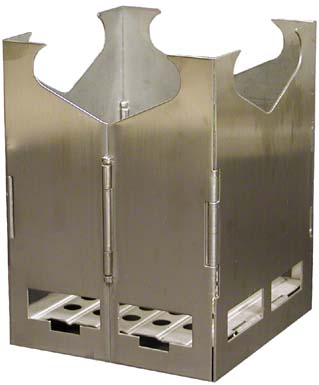
520g Magic Stove
The Swiss Magic Stove is also a nice little stainless setup. Collapses to 4.5" x 5.9" x 0.4".
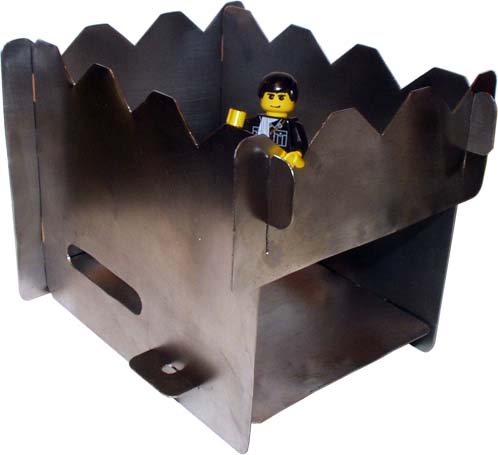
Nimblewill Nomad's Wood Burning Stove with optional front
Nimblewill Nomad's "Little Dandy" is a collapsible stove that can be made form steel, titanium or thick aluminum sheet. It can be heavy (11.5oz range) if you use heavy gauge steel (22GA) but flattens down nicely and is easily packable (although it will not fit in a small pot such as the Grease Pot unless you alter the dimensions). Galvanized steel is never recommended as it releases heavy metals into the air when heated, but titanium makes great lightweight heat resistant walls. See the template page for templates.
If you are not up to making one of these yourself, Chris Randall was willing to send you one from the UK for about US$25 plus shipping. According to Chris, the Kelly Kettle fits right on to of the Nomad without modification.
Calculated weight estimates for Nimblewill Nomad's Wood Burning Stove
(including optional front)
|
Stainless 22GA |
11.7oz |
|
Stainless 24GA |
9.4oz |
|
Stainless 26GA |
7oz |
|
Stainless 28GA |
5.9oz |
|
Stainless 30GA |
4.7oz |
|
|
|
|
Steel 22GA |
11.4oz |
|
Steel 24GA |
9.1oz |
|
Steel 26GA |
6.8oz |
|
Steel 28GA |
5.7oz |
|
Steel 30GA Side of solvent can 0.012" |
4.6oz |
|
|
|
|
Titanium 22GA |
6.7oz |
|
Titanium 24GA |
5.3oz |
|
Titanium 26GA |
4.0oz |
|
Titanium 28GA Thru-Hiker's 0.016" |
3.3oz |
|
Titanium 30GA |
2.7oz |
Can/Tube Stoves
Simpler stove designs don't require watertight joints, fans or electricity. Some are basically ventilated steel cans or tubes, while others are much more sophisticated with well designed ventilation which promote gasification and more complete burning of fuel.
There have been many manufactured portable designs dating back to at least the 1800s made of steel and more recently with titanium. Homemade versions can generally be fabricated from cans, pots (such as light weight titanium pots), or metal sheet. Aluminum flashing may seem like a great option for a light weight hiker on a budget, and it may work for a few fire-ups but will burn up after you get it hot enough. See our Potstand page for information and calculators that will help with design planning.
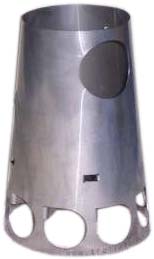
14.8 oz Trailstove
The US$20 Trailstove comes with a hose and tube for blowing. This simple and relatively lightweight conical design allows for reasonably efficient burning of twigs and wood found in nature without the complexity of fans or moving parts. The use of a tube and hose for blowing a nice addition when trying to burn less than completely dry fuel.
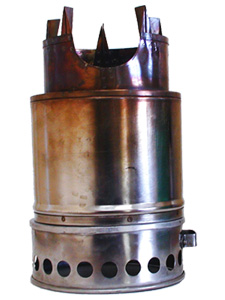
21.5oz Trekstov
More sophisticated versions have adjustable ventilation and are built sturdy (and heavy) for long term use. The MAGH Twister Stove is an example of a double walled vortex stove which uses centrifugal decomposition to mix smoke with air for a more complete burn. This allows for longer cooking with less fuel and is durable enough to throw in your canoe without too much worry of it being crushed.
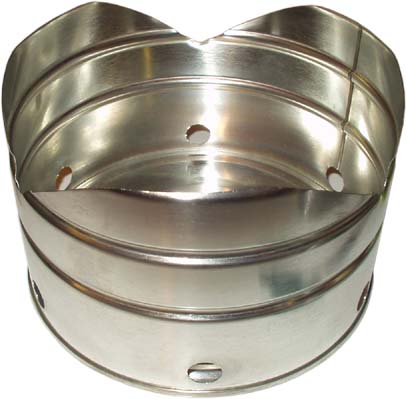
Trimmed 26oz Coffee Can (3.5oz)
Simple homemade versions can be made from trimmed down tin cans with bottom ventilation (a church key or unibit works well for this). These wood burners may also double and pot stands for alcohol and/or solid fuel stoves. A slightly lighter, rustproof and much more expensive stove may be fabricated from a titanium pot.
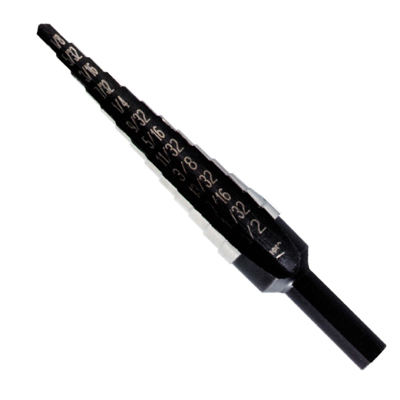
Unibit - ideal for making or enlarging holes in thin metal
Tools such as the Unibit shown above allow you to make nice clean holes in the side of steel or titanium. These are nice if your end goal is to make a stove which not only works, but looks nice to boot.
WoodGas Stoves
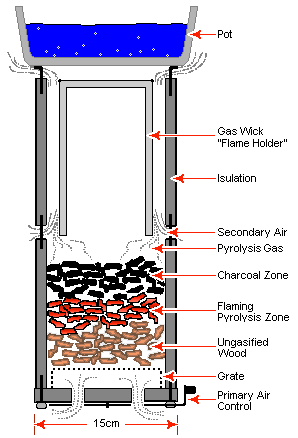
Image modified from:
A Wood-Gas Stove for
Developing Countries
T. B. Reed and Ronal Larson
If wood is heated up and gasified, it has the potential of burning more completely, efficiently and with little or no smoke and heavy pollutants. These stoves tend to be a bit more complex than a tin can with holes punched in it and therefore tend to weigh a bit more. There design allows for cleaning cooking with less emissions and better fuel efficiency. This is a great feature for those cooking indoors and with limited resources. If you are a backpacker, this may mean that you can pack less wood pellets or still cook where fuel is more scarce. For more information on wood gasification, check out Wood-Gas Stoves for Developing Countries and Testing and Modeling the Wood Gas Turbo Stove.
The picture above depicts a stove made from coffee cans and is more or less self-explanatory except for the "Gas Wick." The gas wick is a smaller diameter metal can suspended by wires inside the larger coffee can. The smaller can is inverted so that the opening is facing down at the fire. This wick becomes very hot and draws gas and air up along its sides, and prevents air from going down the chimney.
It is also important to note that fuel is ignited from the top down for the gasification process to work.
Caveats
First - If you would like to use wood as a fuel you will need to be able to start a fire. The most important aspect of this is fire starting skill. Learn to start a fire. Here are some basic techniques-
Use small dry twigs or shavings to start and add bigger stuff on top
Pack everything tight, add liquid fuel and light
A fan, tube to blow through, or sleeping pad to wave back and forth may be necessary to get the fire red and hot
Second - You will need a flame or spark, preferably waterproof or in a waterproof container
Lighters
Matches
Magnesium and flint
Steel wool and 9V battery
Battery with wire or aluminum plate to heat up tinder or make a spark
Sparker - sparklite or other doodad
Magnifying glass to concentrate sunlight - can be made form ice or condom filled with water
Parabolic mirror - see Fire from a Can of Coke and a Chocolate Bar Part II
Wood Friction -
Fire Piston - a good DIY project if you are looking for one
Chemical - potassium permanganate and glycerine or antifreeze or sugar
Third - You may need tinder and/or a fire starter, especially if you are likely to have wet or damp wood.
Vaseline soaked cotton (real cotton) balls in film canister
Bottle of liquid fuel such as kerosene or alcohol
Knife to make wood shavings and/or "fuzz sticks" (stick with curls carved on the sides)
Candles (melt wax on kindling)
Folded up wax paper
Cardboard, paper or cotton soaked in wax
Lint from dryer
Fuel tabs
Commercial fire starter sticks
Fire starter paste
Dry pine needles, leaves, grass, bark, small twigs, etc.
Finished pages from novel/guide book
Char cloth in waterproof container or bag
Soap coated steel wool
Frayed rope (not treated with fire retardant and made from plant fibers)
First Aid/Hygiene kit items - cotton dressings, Vaseline impregnated dressings, toiled paper, Q-tips, tampons, etc.
Shaved magnesium
gunpowder from bullet
small piece of plastic explosive
Fourth - Unless you are packing in wood and packing out ash, wood stoves are not entirely "leave no trace." Beware of uppity and/or extremist hikers and rangers who might frown on you burning up their wilderness. That and you might just be part of a real eco problem - depending on where you decide to use a wood stove.
Beyond wood, many other biofuels may be burned. You can use agricultural waste, paper products, dried humanimal waste, coal, charcoal, manufactured fire logs, last year's fruitcake, etc.
|
Firewood Quality |
|||||||
|
Hard Woods |
|||||||
|
Species |
Heat |
Weight* |
Ease Of Splitting |
Ease Of Starting |
Coaling Qualities |
Sparks |
Fragrance |
|
Alder |
Medium-Low |
2506 |
Easy |
Fair |
Good |
Moderate |
Slight |
|
Apple |
High-Medium |
4132 |
Difficult |
Difficult |
Excellent |
Few |
Excellent |
|
Ash , Black |
Medium |
4132 |
Easy-Moderate |
Fair-Difficult |
Good-Excellent |
Few |
Slight |
|
Ash, Green |
High |
3590 |
Easy-Moderate |
Fair-Difficult |
Good-Excellent |
Few |
Slight |
|
Ash, White |
High |
3,689 |
Easy-Moderate |
Fair-Difficult |
Good-Excellent |
Few |
Slight |
|
Species |
Heat |
Weight* |
Ease Of Splitting |
Ease Of Starting |
Coaling Qualities |
Sparks |
Fragrance |
|
Aspen, Bigtooth |
Low |
2439 |
Easy |
Easy |
Good |
Few |
Slight |
|
Aspen, Quaking |
Low |
2373 |
Easy |
Easy |
Good |
Few |
Slight |
|
Basswood |
Low |
2174 |
Easy |
Easy |
Poor |
Few |
Good |
|
Beech |
High |
3757 |
Difficult |
Difficult |
Excellent |
Few |
Good |
|
Beech, American |
High |
3793 |
Difficult |
Difficult |
Excellent |
Few |
Good |
|
Species |
Heat |
Weight* |
Ease Of Splitting |
Ease Of Starting |
Coaling Qualities |
Sparks |
Fragrance |
|
Beech, Blue |
High |
3890 |
Difficult |
Difficult |
Excellent |
Few |
Good |
|
Birch, White |
Medium |
3179 |
Easy |
Easy |
Good |
Moderate |
Slight |
|
Birch, Sweet |
Medium |
4065 |
Easy |
Easy |
Good |
Moderate |
Slight |
|
Birch, Gray |
Medium |
3179 |
Easy |
Easy |
Good |
Moderate |
Slight |
|
Birch, Paper |
Medium |
3260 |
Easy |
Easy |
Good |
Moderate |
Slight |
|
Species |
Heat |
Weight* |
Ease Of Splitting |
Ease Of Starting |
Coaling Qualities |
Sparks |
Fragrance |
|
Birch, Yellow |
High-Medium |
3723 |
Moderate |
Easy |
Good |
Moderate |
Slight |
|
Birch, Black |
High-Medium |
3890 |
Moderate |
Easy |
Good |
Moderate |
Slight |
|
Buckeye, Horsechestnut |
Low |
2235 |
Moderate |
|
Poor |
Few |
Slight |
|
Boxelder |
Low |
2797 |
Easy |
|
Poor |
Many |
Slight |
|
Butternut (white walnut) |
Low |
2440 |
Easy |
|
|
|
|
|
Species |
Heat |
Weight* |
Ease Of Splitting |
Ease Of Starting |
Coaling Qualities |
Sparks |
Fragrance |
|
Catalpa |
Low |
2360 |
Difficult |
|
Good |
Few |
Fair |
|
Cherry, Black |
Medium |
2880 |
Easy |
Difficult |
Excellent |
Few |
Excellent |
|
Cherry |
Medium |
3184 |
Easy |
Difficult |
Excellent |
Few |
Excellent |
|
Chestnut |
Low |
2708 |
Easy |
|
|
Many |
Good |
|
Coffeetree, Kentucky |
High |
3112 |
Moderate |
|
Good |
Few |
Good |
|
Species |
Heat |
Weight* |
Ease Of Splitting |
Ease Of Starting |
Coaling Qualities |
Sparks |
Fragrance |
|
Cottonwood |
Low |
2102 |
Easy |
Easy |
Good |
Moderate |
Slight |
|
Dogwood |
High |
4331 |
Difficult |
Good |
Fair |
Few |
|
|
Elm, American |
Medium |
3116 |
Very Difficult |
Fair |
Good |
Very Few |
Fair |
|
Elm, Rock |
Medium |
3860 |
Very Difficult |
Fair |
Good |
Very Few |
Fair |
|
Elm, Siberian |
Medium |
3020 |
Very Difficult |
Fair |
Good |
Very Few |
Fair |
|
Species |
Heat |
Weight* |
Ease Of Splitting |
Ease Of Starting |
Coaling Qualities |
Sparks |
Fragrance |
|
Elm, Slippery |
Medium |
3251 |
Very Difficult |
Fair |
Good |
Very Few |
Fair |
|
Eucalyptus |
Very High |
4560 |
|
|
|
|
|
|
-Swamp yate |
|
|
Difficult |
Poor |
Excellent |
Few |
Good |
|
-Sugar gum |
|
|
Difficult |
Poor |
Excellent |
Few |
Good |
|
-Tasmanian blue gum |
|
|
Fair |
Fair |
Good |
Few |
Good |
|
Species |
Heat |
Weight* |
Ease Of Splitting |
Ease Of Starting |
Coaling Qualities |
Sparks |
Fragrance |
|
-River red gum |
|
|
Difficult |
Poor |
Excellent |
Moderate |
Good |
|
-SA blue gum |
|
|
Difficult |
Poor |
Excellent |
Few |
Good |
|
Hackberry |
High |
3319 |
Easy |
|
Good |
Few |
Slight |
|
Hazel |
High |
|
Moderate |
Moderate |
|
|
|
|
Hawthorn |
High |
|
Moderate |
Moderate |
|
|
|
|
Species |
Heat |
Weight* |
Ease Of Splitting |
Ease Of Starting |
Coaling Qualities |
Sparks |
Fragrance |
|
Hickory, True |
Very High |
4,327 |
Moderate |
Fair-Difficult |
Excellent |
Moderate |
Excellent |
|
Hickory, Mockernut |
Very High |
4332 |
Moderate |
Fair-Difficult |
Excellent |
Moderate |
Excellent |
|
Hickory, Pignut |
Very High |
4332 |
Moderate |
Fair-Difficult |
Excellent |
Moderate |
Excellent |
|
Hickory, Shagbark |
Very High |
4333 |
Moderate |
Fair-Difficult |
Excellent |
Moderate |
Excellent |
|
Hickory, Shellbark |
Very High |
4195 |
Moderate |
Fair-Difficult |
Excellent |
Moderate |
Excellent |
|
Species |
Heat |
Weight* |
Ease Of Splitting |
Ease Of Starting |
Coaling Qualities |
Sparks |
Fragrance |
|
Holly, American |
|
3387 |
Difficult |
|
|
|
|
|
Honeylocust |
High |
3832 |
Easy |
|
Excellent |
Few |
Slight |
|
Hophornbeam, Eastern |
|
4266 |
|
|
|
|
|
|
Ironwood (Hornbeam) |
Very High |
4267 |
Very Difficult |
Very Difficult |
Excellent |
Few |
|
|
Laurel, California |
|
3456 |
|
|
|
|
|
|
Species |
Heat |
Weight* |
Ease Of Splitting |
Ease Of Starting |
Coaling Qualities |
Sparks |
Fragrance |
|
Locust, Black |
Very High |
4470 |
Very Difficult |
Difficult |
Excellent |
Very Few |
Slight |
|
Madrone |
High |
3925 |
Difficult |
Difficult |
Excellent |
Very Few |
Slight |
|
Maple, Bigleaf |
High-Medium |
2980 |
Moderate |
Fair-Difficult |
Excellent |
Few |
Excellent |
|
Maple, Silver |
High-Medium |
2981 |
Moderate |
Fair-Difficult |
Excellent |
Few |
Fair |
|
Maple, Black |
High-Medium |
3523 |
Moderate |
Fair-Difficult |
Excellent |
Few |
Excellent |
|
Species |
Heat |
Weight* |
Ease Of Splitting |
Ease Of Starting |
Coaling Qualities |
Sparks |
Fragrance |
|
Maple, Soft |
High-Medium |
2924 |
Moderate |
Fair-Difficult |
Excellent |
Few |
Excellent |
|
Maple, Red |
High-Medium |
3318 |
Moderate |
Fair-Difficult |
Excellent |
Few |
Excellent |
|
Maple, Sugar |
High |
3793 |
Moderate |
Difficult |
Excellent |
Few |
Excellent |
|
Mesquite |
Very High |
|
Very Difficult |
Very Difficult |
Excellent |
Few |
|
|
Mulberry |
Medium |
3712 |
Easy |
|
Excellent |
|
Good |
|
Species |
Heat |
Weight* |
Ease Of Splitting |
Ease Of Starting |
Coaling Qualities |
Sparks |
Fragrance |
|
Oak, Bur |
High |
3928 |
Easy |
Difficult |
Excellent |
Few |
Fair |
|
Oak, Red |
High |
3680 |
Moderate |
Difficult |
Excellent |
Few |
Fair |
|
Oak, White |
Very High |
4200 |
Moderate |
Difficult |
Excellent |
Few |
Excellent |
|
Osage Orange |
High |
4728 |
Moderate |
|
Excellent |
Many |
Excellent |
|
Pecan |
High |
|
Moderate |
|
Good |
Few |
Good |
|
Species |
Heat |
Weight* |
Ease Of Splitting |
Ease Of Starting |
Coaling Qualities |
Sparks |
Fragrance |
|
Persimmon |
|
4332 |
Moderate |
|
|
|
|
|
Pine, Lodgepole |
Low |
2610 |
Easy |
Easy |
Fair |
Moderate |
Good |
|
Poplar, Yellow (Tuliptree) |
Low |
2708 |
Easy |
Easy |
Fair |
Moderate |
Bitter |
|
Sweet Gum |
Medium |
3115 |
Difficult |
Fair |
Fair |
Few |
|
|
Sycamore |
Medium |
3115 |
Difficult |
Very Difficult |
Good |
Few |
Good |
|
Species |
Heat |
Weight* |
Ease Of Splitting |
Ease Of Starting |
Coaling Qualities |
Sparks |
Fragrance |
|
Walnut |
High-Medium |
3454 |
Moderate |
Fair |
Good |
Few |
Fair |
|
Willow |
Low |
2438 |
Easy |
Fair |
Poor |
Moderate |
Slight |
|
|
|||||||
|
Soft Woods |
|||||||
|
Species |
Heat |
Weight* |
Ease Of Splitting |
Ease Of Starting |
Coaling Qualities |
Sparks |
Fragrance |
|
Cedar, White |
Medium-Low |
2100 |
Easy |
Easy |
Poor |
Moderate |
Excellent |
|
Cedar, Eastern |
Medium-Low |
2981 |
Easy |
Easy |
Poor |
Many |
Excellent |
|
Cedar, W. Red |
Medium-Low |
2100 |
Easy |
Easy |
Poor |
Many |
Excellent |
|
Cypress |
Medium |
2844 |
Easy |
Moderate |
|
Few |
|
|
Fir, Douglas |
Medium |
3049 |
Easy |
Easy |
Fair |
Moderate |
Slight |
|
Species |
Heat |
Weight* |
Ease Of Splitting |
Ease Of Starting |
Coaling Qualities |
Sparks |
Fragrance |
|
Fir, Balsam |
Low |
2236 |
Easy |
Easy |
Fair |
Moderate |
Slight |
|
Fir, Grand |
Low |
2371 |
Easy |
Easy |
Fair |
Moderate |
Slight |
|
Fir, White |
Low |
2104 |
Easy |
Easy |
Fair |
Moderate |
Slight |
|
Hemlock, Eastern |
Medium-Low |
2573 |
Easy |
Easy |
Poor |
Many |
Good |
|
Hemlock, Western |
Medium-Low |
2847 |
Easy |
Easy |
Poor |
Many |
Good |
|
Species |
Heat |
Weight* |
Ease Of Splitting |
Ease Of Starting |
Coaling Qualities |
Sparks |
Fragrance |
|
Juniper |
Medium |
3150 |
Medium |
|
Poor |
Many |
Excellent |
|
Larch, Western (Tamarack) |
High-Medium |
3318 |
Easy-Moderate |
Easy-Fair |
Fair |
Many |
Slight |
|
Pine, Lodgepole |
Low |
2576 |
Easy |
Easy |
Fair |
Moderate |
Good |
|
Pine, Ponderosa |
Medium-Low |
2573 |
Easy |
Easy |
Fair |
Moderate |
Good |
|
Pine, E&W White |
Medium-Low |
2303 |
Easy |
Easy |
Fair |
Moderate |
Good |
|
Species |
Heat |
Weight* |
Ease Of Splitting |
Ease Of Starting |
Coaling Qualities |
Sparks |
Fragrance |
|
Pine, Sugar |
Low |
2302 |
Easy |
Easy |
Fair |
Moderate |
Good |
|
Pine, Yellow |
High-Medium |
2610 |
Easy |
Easy |
Fair |
Moderate |
Good |
|
Pinon |
High |
3000 |
Easy |
|
|
Many |
|
|
Redwood, Old Growth |
Medium |
2573 |
Easy |
Easy-Fair |
Poor |
Many |
Slight |
|
Redwood, Second Growth |
Medium |
2302 |
Easy |
Easy-Fair |
Poor |
Many |
Slight |
|
Species |
Heat |
Weight* |
Ease Of Splitting |
Ease Of Starting |
Coaling Qualities |
Sparks |
Fragrance |
|
Spruce, Black |
Low |
2575 |
Easy |
Easy |
Poor |
Few |
Slight |
|
Spruce, Engeiman |
Low |
2234 |
Easy |
Easy |
Poor |
Few |
Slight |
|
Spruce, Norway |
Low |
2240 |
Moderate |
Easy |
Poor |
Many |
Slight |
|
Spruce, Sitka |
Low |
2506 |
Easy |
|
Poor |
|
Slight |
|
Yew |
High |
|
Difficult |
Difficult |
|
|
Good |
|
*Weight - pound /cord - seasoned wood. Cord - stack 4' x 4' x 8' feet high (~85 ft3 with air space removed) Face cords - 4' x 8' x <4' (usually about 16" deep) |
|||||||
Alder: Poor heat output and short lasting. A low quality firewood. Produces nice charcoal that burn steady and is useful for homemade gunpowder.
Apple: Great fuel that bums slow and steady when dry, with little flame, sparking or spitting. It has a pleasing scent. It is easier to cut green. Great for cooking.
Ash: Considered one of the burning wood with steady flame and good heat output. It will bum when green, but not as well as when dry. Easily to saw and split.
Beech: Similar to ash, but only burns fair when green. If it has a fault, it may shoot embers out a long ways. It is easy to chop.
Birch: This has good heat output but burns quickly. The smell is also pleasant. It will burn unseasoned. Can cause gum deposits in chimney if used a lot. Rolled up pitch from bark makes a good firestarter and can be peeled from trees without damaging them.
Blackthorn: Burns slowly, with lots of heat and little smoke.
Cedar: This is a great wood that puts out a lot of lasting of heat. It produces a small flame, a nice scent, and lots of crackle and pop. Great splitting wood. Best when dry but small pieces can be burned unseasoned. Good for cooking.
Cherry: A slow burning wood with good heat output. Has a nice sent. Should be seasoned well. Slow to start.
Chestnut: A mediocre fuel that produces a small flame and weak heat output. It also shoots out ambers.
Douglas Fir: A poor fuel that produces little flame or heat.
Elder: A mediocre fuel that burns quickly without much heat output and tends to have thick acrid smoke. The Hag Goddess is know to reside in the Elder tree and burning it invites death. Probably best avoided.
Elm: A variable fuel (Dutch elm disease) with a high water content (140%) that may smoke violently and should be dried for two years for best results. You may need faster burning wood to get elm going. A large log set on the fire before bed will burn till morn. Splitting can be difficult and should be done early on.
Eucalyptus: A fast burning wood with a pleasant smell and no spitting. It is full of sap and oils when fresh and can start a chimney fire if burned unseasoned. The stringy wood fiber may be hard to split and one option is to slice it into rings and allow to season and self split. The gum from the tree produces a fresh medicinal smell on burned which may not be the best for cooking with.
Hawthorn: Good firewood. Burns hot and slow.
Hazel: An excellent fast burning fuel but tends to burn up a bit faster than most other hard woods. Allow to season.
Holly: A good firewood that will burn when green, but best if dried a year. It is fast burning with a bright flame but little heat.
Hornbeam: Burns almost as good as beech with a hot slow burning fire.
Horse Chestnut: A low quality firewood with a good flame and heating power but spits a lot.
Laburnum: Completely poisonous tree with acrid smoke that taints food and is best never used.
Larch: Crackly, scented, and fairly good for heat. It needs to be seasoned well and forms an oily soot in chimneys.
Laurel: Produces a brilliant flame.
Lime: A poor quality fuel with dull flame. Good for carving
Maple: A good firewood.
Oak: Oak has a sparse flame and the smoke is acrid if not seasoned for two years. Dry old oak is excellent for heat, burning slowly and steadily until whole log collapses into cigar-like ash.
Pear: Burns with good heat, good scent and no spitting. Needs to be seasoned well.
Pine: Bums with a splendid flame, but apt to spit. Needs to be seasoned well and is another oily soot in chimney wood. Smells great and its resinous wood makes great kindling.
Plane: Burns pleasantly, but is apt to throw sparks if very dry.
Plum: Wood provides good heat with a nice aromatic sent.
Poplar: A terrible fuel that doesn't burn well and produces a black choking smoke even when seasoned.
Rowan: A good firewood that burns hot and slow.
Rhododendron: Old thick and tough stems burn well.
Robinia (Acacia): Burns slowly, with good heat, but with acrid smoke.
Spruce: A poor firewood that burns too quickly and with too many sparks.
Sycamore: Burns with a good flame, with moderate heat. Useless green.
Sweet Chestnut: Burns when seasoned but tends to spits continuously and excessively.
Thorn: One of the best firewood. Burns slowly, with great heat and little smoke.
Walnut: Low to good value to burning. It a nice aromatic scent.
Wellingtonia: Poor for use as a firewood.
Willow: A poor fire wood that must be dry to use. Even when seasoned, it burns slowly, with little flame. Apt to spark.
Yew: This burns slowly, with fierce heat. The scent is pleasant. Another carving favorite. Note that every part of this plant, except for the fruit contains poisonous taxines. Death to livestock after ingestion of this plant is well documented and here are reported cases of suicides from ingestion of leaves. Sawdust is dangerous if ingested or inhaled. The Romans reported death after ingestion of wine stored in Yew vessels, yet Yew cups, bowls and plates are still very popular - not that this makes them any less poisonous. Taxines are carried in smoke and the safety of using this wood for cooking or heat is questionable.
Rhymes
These hardwoods burn well and slowly,
Ash, beech, hawthorn oak and holly.
Softwoods flare up quick and fine,
Birch, fir, hazel, larch and pine.
Elm and willow you'll regret,
Chestnut green and sycamore wet
Beechwood fires are bright and clear
If the logs are kept a year.
Chestnut's only good, they say,
If for long 'tis laid away.
But Ash new or Ash old
Is fit for a queen with crown of gold.
Birch and fir logs bum too fast
Blaze up bright and do not last.
It is by the Irish said
Hawthom bakes the sweetest bread.
Elm wood bums like churchyard mould,
E ' en the very flames are cold.
But Ash green or Ash brown
Is fit for a queen with golden crown.
Poplar gives a bitter smoke,
Fills your eyes and makes you choke.
Apple wood will scent your room
With an incense like perfume.
Oaken logs. if dry and old.
Keep away the winter's cold.
But Ash wet or Ash dry
A king shall warm his slippers by.
Beechwood logs burn bright and clear,
If the wood is kept a year
Store your Beech for Christmas-tide,
With new-cut holly laid aside
Chestnut's only good, they say
If for years it's stored away
Birch and Fir wood burn too fast,
Blaze too bright, and do not last
Flames from larch will shoot up high,
And dangerously the sparks will fly....
But Ashwood green,
And Ashwood brown
Are fit for Queen with golden crown.
Oak logs will warm you well
That are old and dry
Logs of pine will sweetly smell
But the sparks will fly
Birch logs will burn too fast
Chestnut scarce at all sir
Hawthorn logs are good to last
That are cut well in the fall sir
Holly logs will burn like wax
You could burn them green
Elm logs burn like smouldering flax
With no flame to be seen
Beech logs for winter time
Yew logs as well sir
Green elder logs it is a crime
For any man to sell sir
Beechwood fires burn bright and clear
If the logs are kept a year
Store your beech for Christmastide
With new holly laid beside
Chestnuts only good they say
If for years tis stayed away
Birch and firwood burn too fast
Blaze too bright and do not last
Flames from larch will shoot up high
Dangerously the sparks will fly
But Ashwood green and Ashwood brown
Are fit for a Queen with a golden crown
Oaken logs, if dry and old
Keep away the winters cold
Poplar gives a bitter smoke
Fills your eyes and makes you choke
Elmwood burns like churchyard mould
Even the very flames burn cold
Hawthorn bakes the sweetest bread
So it is in Ireland said
Applewood will scent the room
Pears wood smells like a flower in bloom
But Ashwood wet and Ashwood dry
A King may warm his slippers by.
Pear logs and apple logs
They will scent your room
And cherry logs across the dogs
They smell like flowers of broom
But Ash logs smooth and grey
Buy them green or old, sir
And buy up all that come your way
They're worth their weight in gold sir
Logs to Burn, Logs to burn, Logs to burn,
Logs to save the coal a turn,
Here's a word to make you wise,
When you hear the woodman's cries.
Never heed his usual tale,
That he has good logs for sale,
But read these lines and really learn,
The proper kind of logs to burn.
Oak logs will warm you well,
If they're old and dry.
Larch logs of pine will smell,
But the sparks will fly.
Beech logs for Christmas time,
Yew logs heat well.
"Scotch" logs it is a crime,
For anyone to sell.
Birch logs will burn too fast,
Chestnut scarce at all.
Hawthorn logs are good to last,
If you cut them in the fall.
Holly logs will burn like wax,
You should burn them green,
Elm logs like smouldering flax,
No flame to be seen.
Pear logs and apple logs,
They will scent your room,
Cherry logs across the dogs,
Smell like flowers in bloom
But ash logs, all smooth and grey,
Burn them green or old;
Buy up all that come your way,
They're worth their weight in gold.