|
|
Liquefied Gas Stoves
|
|
Contact:
![zenseeker [at] hotmail [dot] com](EmailImage.gif)
Liquefied Petroleum Gas (LPG) Burners
aka Canister Stoves and Gaz Stoves
Liquefied gas stoves are basically oversized Bic lighters. They burn clean and are simple to use. Their only real disadvantages are the heavy (in comparison to disposable plastic bottles for alcohol) non-refillable canisters and poor performance in the extreme cold. In many circumstances, this category of stoves are the best choice hands down.
Advantages include:
many commercial options
high heat output
compact
generally much lighter than liquid petrol stoves
very easy to operate
easy to simmer with
maintenance free
burn clean and relatively quiet
odorless
Disadvantages include:
weight of fuel containers (around half the weight of fuel; but still lighter than metal ones for liquid petrol)
bulk of canisters (if you have to carry more than you need)
heavier than alcohol stoves
non-refillable canister makes weight planning/adjusting difficult for short trips
may not work well at subfreezing temperatures
flame can be easily blown out with wind
hazard if canister damaged
pierceable canisters cannot be removed from stoves without loss of fuel and are dangerous to store on the stove as they may leak
Propane, Butane and Isobutane Stoves
There are many commercial stoves to choose from and they can be broken down into a few basic categories based on where the gas canister is mounted.
Top Mounted Stoves
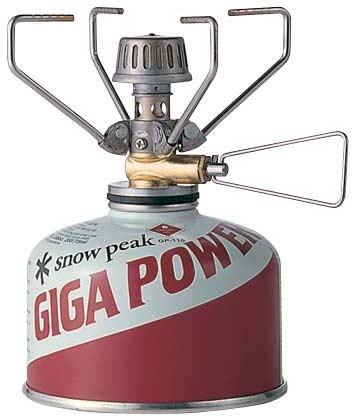
2.5oz Titanium Snow Peak GigaPower (Canister and fuel not included in weight)
The majority of backpacking gas stoves are designed to be mounted right on top of a disposable fuel canister. This allows of a minimal setup which makes the stove both lightweight and easy to pack. The downside of mounting a stove directly over its fuel source is the potential for overheating the fuel and explosion if you use a tight windscreen, or cook for extended periods with a large pan that reflects a good deal of heat back down at the canister.
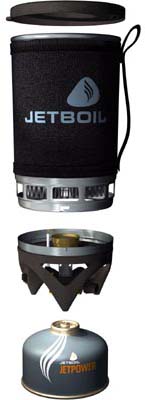
15oz Jetboil System
The Jetboil system incorporates a neoprene insulated pot with a heat exchanger ring on the bottom called the FluxRing. This system is designed to be more efficient with shorter boil times but is still close to a pound and lacks cooking flexibility. It's a step in the right direction and tinkerers may be able to improve on this design. Interesting to note is that the Jetboil system will still work if laid on its side - be careful if the canister is more than 50% full.
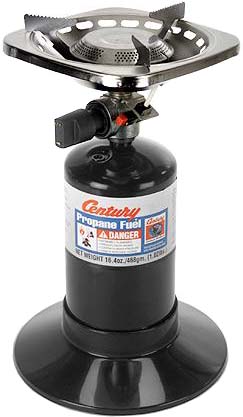
20oz Century Matchless Single-Burner Stove (Canister and fuel not included in weight)
Although most propane stove designs use a hose to connect to a propane canister, a few allow them to be mounted directly on a small propane tank. This makes them a little easier to pack but tend to be too heavy and bulky for most kinds of backpacking.
Remote Canister Stoves
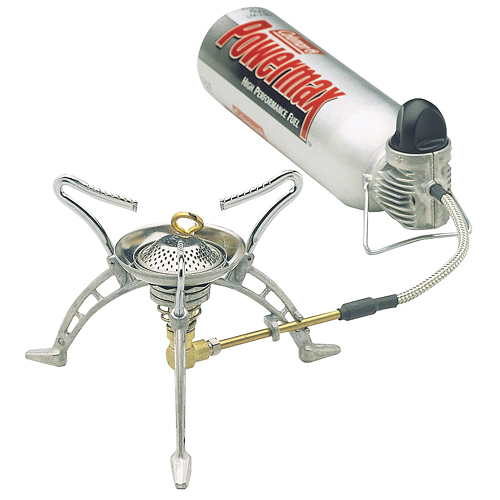
11oz Coleman Xtreme
The Coleman PowerMax line of stoves use a special canister designed to pick up the liquid fuel at the bottom of the canister instead of gas fuel at the top. This is a superior design for butane-propane mixed fuel in sub-freezing temperatures as the propane gas will continue to pressurize the fuel and feed the stove instead of being used up first and leaving the majority of the butane unusable. The Powermax canisters were also made from thick aluminum which insulates better than thin steel and are more recyclable (there's even a puncture key supplied with the stove). The fuel mix also made up of a whopping 40% propane. It may be possible to use 7/16 NS threaded Lindal canisters either right side up or upside down if you can't find this unique fuel for your stove- but do so at your own risk.
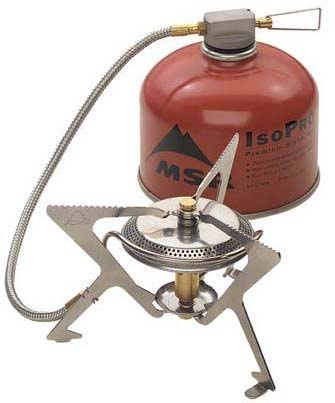
6.8oz MSR WindPro
The MSR WindPro, MSR Rapidfire, Snowpeak GigaPower BF [GS-300A], Markill Spider, Primus Himalaya EasyFuel and many other stoves connect to the fuel canister remotely and allow for a traditional windscreen to be placed around the stove without fear of overheating the canister. This design also allows for a sturdier platform for pots than canister mounted stoves and is easier to find fuel for than the Coleman PowerMax.
Not having the stove mounted on top of your canister allows you to utilize some special techniques. It is possible to run a regular canister upside down, which maximizes the vaporization of the propane in your canister during subfreezing temperatures similar to the Coleman PowerMax canister's use of propane pressure to drive liquid fuel to the stove. See Cold Weather Operations below for more information.
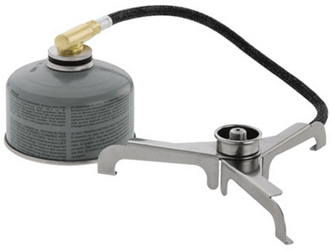
6.8oz Markill Stove Base Adapter Dead Link
Markill and other companies have offered stands for canister mounted stoves that allows you to connect a stove designed to be mounted above a canister to your fuel canister remotely with a hose. This allows for better stability, the safe use of a tight windscreen and per Markill - "when it's extremely cold the cartridge can be placed near the burner for warmth, helping to increase burning power."
Side Mounted Stoves
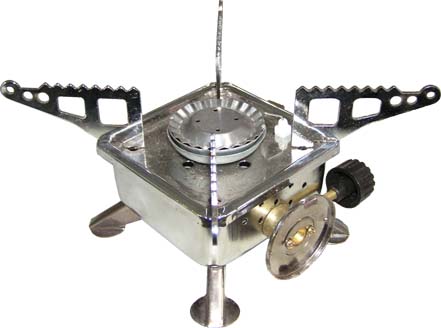
Gas stoves that mount their canister horizontally are not very common in the US or European backpacking community, but are much more common in Asia. These may be the stove of choice for traveling though populated areas of many parts of Asia, where the special canisters needed for these stoves are easy to find and cheap.
Refillable Gas Stoves
18oz Pocket Stove
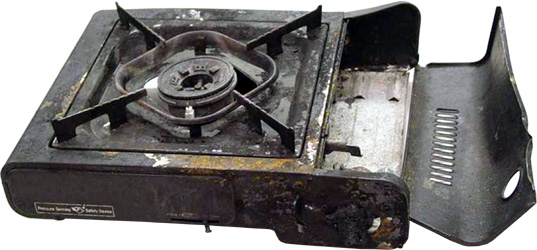
Refillable butane stoves, such as this hefty 18 ouncer, tend to be much heavier than canister stoves and are more suitable for boats, cars and demonstrations than backpacking.
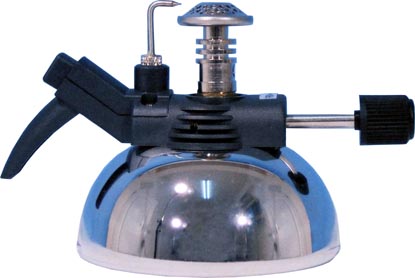
Mini 3hour refillable stove
There are a few refillable stoves that are somewhat more suitable for some backpacking use and have the advantage of being refillable with easy to find butane canisters used for refilling gas lighters. These stoves are difficult to find in the Western world.
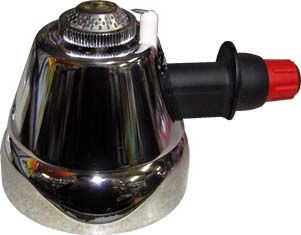
Roburn Micro Burner
Some of these mico stoves were designed for use with fondue sets or in chemistry labs.
Propane, Butane and Isobutane all have similar heat values and work more or less the same above freezing temperatures. These fuels will not work well bellow their respective boiling points since they won't be able to build up sufficient pressure for stove operation. So the differences in fuel performance for the most part relates to fuel's boiling points and use in low temperatures. The lower the boiling point, the less likely it will fail in the cold.
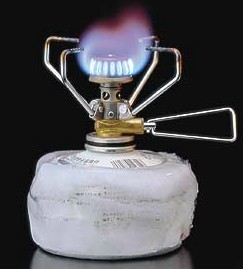
It is important to note that the known boiling point of your fuel isn't necessarily the lowest temperature you would be able to operate in a stove in the real world. For a stove to operate, you need to have enough gas pressure above the atmospheric pressure to force enough gas out of your stove to stay lit. And since fuel continues to cools off as it vaporizes (latent heat of vaporization) and feeds your stove, your fuel must be warm enough to allow for the loss of a few degrees for it so still work long enough to finish cooking or to allow for thermal feedback from the stove.
As you climb in altitude, the boiling point of fuel and water decrease as atmospheric pressure decreases. Higher altitudes actually allow gas stoves to operate at lower temperatures. On the downside, cook times are increased as boiling water isn't as hot as it is at sea level. Plus, decreased oxygen levels at high altitude will decrease stove performance and require it to run longer and use up more fuel.
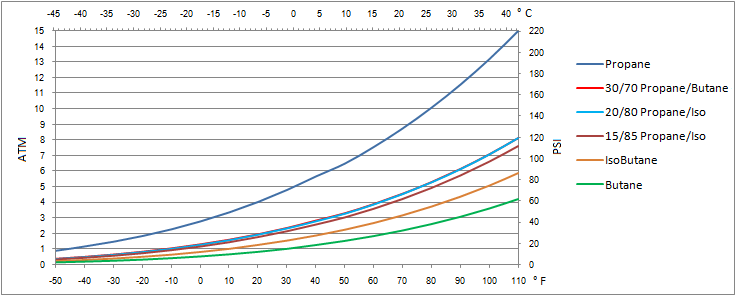
Vapor Pressure of Propane, Isobutane and Butane
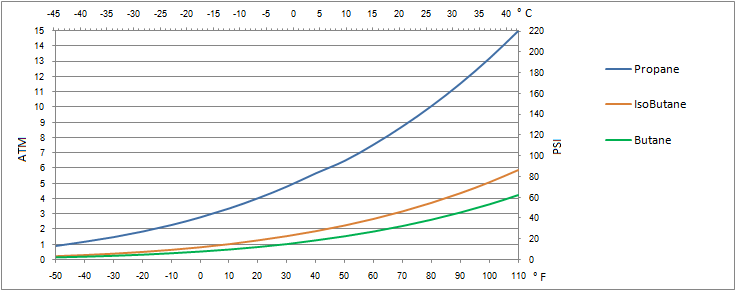
Fuel needs to exceed the atmospheric pressure (1 ATM at sea level) to boil and vaporize.
|
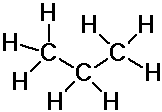
Propane (LPG, Liquefied Propane Gas)
|
|
|
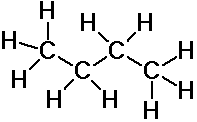
Butane (n-butane)
|
|
|
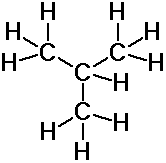
Isobutane
|
|
|
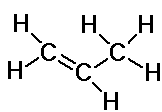
Propene (aka propylene, methylethylene and MAPP Gas)
|
|
Fuel Mixes
Vapor Pressure vs Temperature of Propane/IsoButane/Butane Mixes
Note the minimal difference between the 3 mixed Fuels shown above
The Coleman 30/70 and MSR 20/80 are almost identical here
This may represent the maximum pressures allowed by law for these canisters
Isobutane and/or propane are often added to butane to allow stoves and lanterns to operate at subfreezing temperatures. These fuel mixes don't affect the vaporization of butane and each fuel vaporizes separately. This is important to know because at temperatures below the boiling point of butane, the added fuels will vaporize and be used up first. If your canister isn't warmed by heat from the burning of the more volatile fuels by the stove, these fuels will burn off first and leave you with cold and unusable butane remaining.
Here is the same chart as shown above magnified
The boiling point of each of these gases is around the 1 ATM level at sea level
Isobutane/Butane Blends
Basically, isobutane may allow you to operate your stove at subfreezing temperatures down to 11° F (-12°C) at sea level, that is - until the isobutane runs out.
Propane mixes (20-40% Propane) (Butane/Propane, Butane/Isobutane/Propane, Isobutane/Propane, IsoPro, IsoPropane)
The higher the propane content, the longer it will burn at lower temperatures. You may still end up with most of the butane and/or isobutane remaining in the canister if using a stove below 31° F (0.5°C) or 11° F (-12°C) respectively depending on altitude.
Isopropane
The term isopropane suggests that this is structural isomer of propane, but since propane is a three carbon hydrocarbon, a structural isomer doesn't exist. Isopropane is instead a commercial term used to describe isobutane/propane mixes (and sometimes butane/propane mixes). Manufactures claim this combo is great for low temperature use and improves fuel performance by decreasing the tapering off affect of butane alone.
Fuel cartridges for stoves come in a couple of different styles. Make sure you know what style your stove uses before purchasing fuel. Generally speaking, the top fuel port style on the canister determines what stoves will work on it. If your stove can be attached to the top fuel port on a particular canister, you should be able to use it regardless of brand. Do note that fuel blends vary a bit between manufacture and isobutane and propane fuels may produce too much pressure for poorly made stoves designed for butane only .
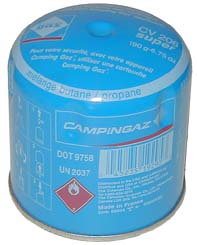
CV206 Pierceable Canister
The EN 417 Type 200 (C100 and C200 series) pierceable/puncture/nonresealable canisters are made for one time attachment and must be used completely before removing. These tend to be cheaper (half the price) than other canister types and may be the only available canister depending on what country you are in. Once you puncture them, they must stay on your stove or lantern until all the fuel is used up and because of this, they create a fire/explosion hazard if your stove, lantern or canister leaks while packed in your ruck or in the back of your car.
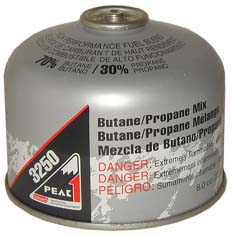
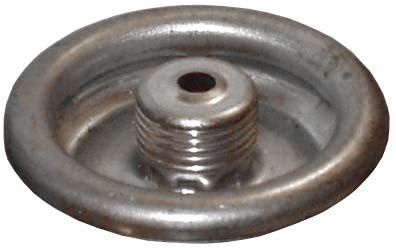
Resealable Nonrefillable Threaded Canister
Currently, the most popular backpacking canister stoves use canisters with a 7/16 NS threaded Lindal (New Link B188) resealable valve. These canisters share the same universal threaded female valve fitting made for EN 521 appliances, allow for removal of the fuel cartridge between use and are safer for transport than pierceable canisters. Canisters of this design are generally made of thin material, don't have a bleeder/dump valve and are considered nonrefillable. Off brand canisters found in Asian may not thread or seal correctly. Tall and narrow threaded butane canisters resembling spray cans may also be found at very cheap prices, but make poor stove bases for canister mounted stoves.
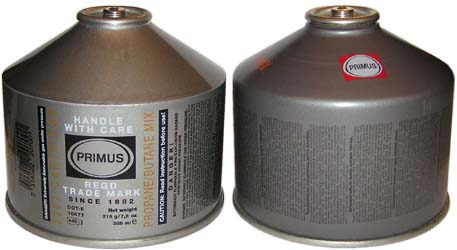
215gram Aluminum and 225gram Steel Primus Canisters
Not all threaded canisters are created equal. Primus produced both aluminum and steel canisters. The aluminum canisters are lighter and can be identified by their sharp shoulders (left above).
Note: These threaded canisters are often referred to as "universal EN417" canisters by many sources, including several manufactures. EN417 actually refers to a CEN (Conseil Européen pour la Normalisation) Standard for "non-refillable metallic gas cartridges for liquefied petroleum gases, with or without a valve, for use with portable appliances - Construction, inspection, testing and marking." Since the pierceable canister shown above also meets EN417 specifications, there can be some confusion when a canister is solely referred to as EN417 compatible.
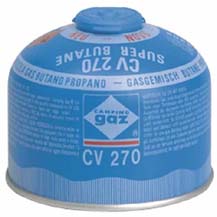
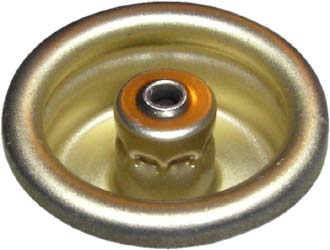
"Easy Clic" Resealable Nonrefillable Unthreaded Canister
The French Campingaz CV line (also used with the US Coleman line) of stoves and lanterns use there own "Easy Clic" resealable system with a port similar to the screw on types, but without the threads and a deeper depression around the fuel port. Its stoves and lanterns easily clip and unclip from the canister with a slight twist of a plastic lever. The multi mount on the MSR SuperFly should work with this canister design (while retaining its ability to use threaded canisters).
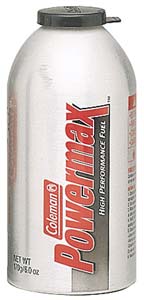
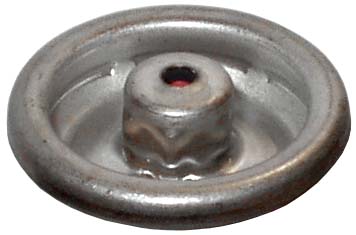
PowerMax 60/40 Butane/Propane
Coleman has (some have been discontinued) an aluminum (making it the lightest canister around) PowerMax canister with a top similar to the threaded Lindal but with a hexagon shaped fuel valve instead of threads. It has a weighted diptube that picks up liquid gas at the bottom of the bottle. Well suited for lower temperatures, this design forces out mixed liquid fuel instead of just propane gas when the canister temperature drops below freezing. They're designed to be used sideways with the heavy Coleman line of Max stoves and make poor stove bases since they are tall and narrow. These canisters generally will not work with non Powermax stoves without modifications since the hexagon top has a larger diameter than other tops.
|
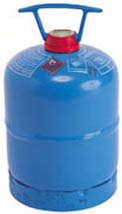
Campingaz 901 450g Refillable Butane Canister |
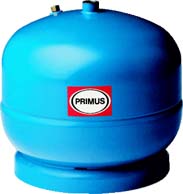
8.2lb Primus Propane Cylinder |
Heavy duty steel refillable canisters can be refilled or exchanged at special shops in Europe. Only certain stoves and lanterns will fit on these and the canisters as well as there stoves are generally more suitable for carvan camping than backpacking.
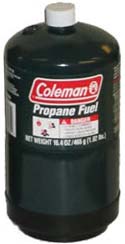
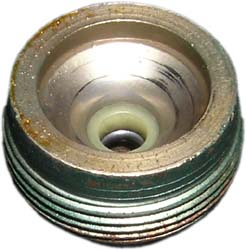
Coleman 465g Propane Fuel Cylinder
Several companies in the US market a heavy steel propane fuel canister with bleeder/dump valves for camping. The handling and storage information provided by the manufactures state to never refill these cylinders and that Federal law in the US forbids transportation if refilled. These, like the stoves and lanterns that work with them, are great for car camping but are generally too heavy to be suitable for most backpackers' needs. That said, they are generally much easier to find (Wal-Mart and hardware stores) and much cheaper than butane canisters. Propane fuel is also preferred over butane fuel for very low temperature use.
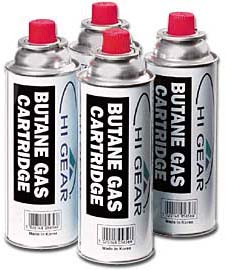
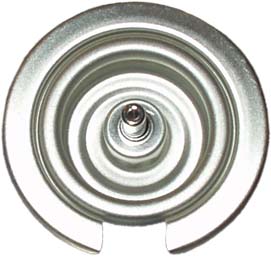
There are several companies that make butane cartridges for portable stoves. One such design has a bayonet male fitting and a collar with a notch in it. These canister may cost a little less than their wider based brothers and may be easier to pack. You may be able to find these canisters at boat shops for a price or at Asian markets for very very cheap. The notch marks where the tube hidden within points. If you run the canister sideways with the notch up, your canister will deliver fuel vapors. If you run the canister with the notch pointed down, your canister will deliver liquid fuel.
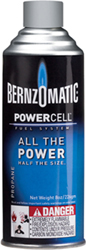
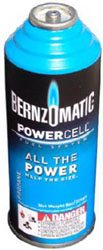
BernzOmatic Powercell Fuel Cylinder (PC8)
BernzOmatic Powercell Fuel Cylinder (PC8) - 8oz propane fuel cylinder. Made for BernzOmatic PowerCell torch, it is one of the best canisters ever made which can be used with a remote feed stove. Too bad they have been discontinued. See adventuresinstoving.blogspot 100% propane-for-backpacking-yes.
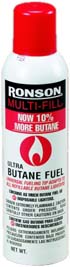
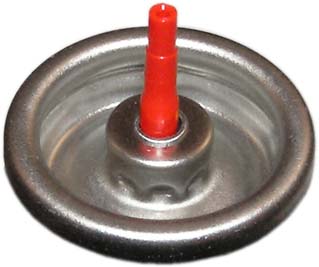
Generally for refilling butane lighters, male universal fueling tip (nipple tip, bayonet end) canisters can be used with a few portable stoves and lanterns that have built in fuel chambers. Canisters of this design are usually filled with butane only, but a few manufactures sell isobutane filled canisters as well.
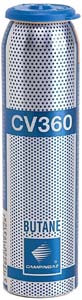
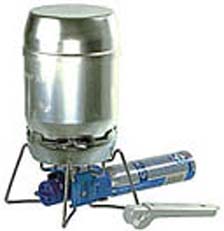
Coleman CV 360 Canister for Rando 360 stove
There are a couple of unique setups and canisters out there such as the Coleman CV 360 made for the Rando 360 show above. The CV 360 has a resealable top similar to other Campingaz canisters, but the depression isn't as deep.
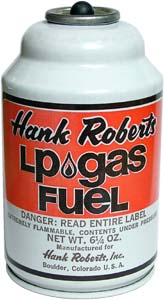
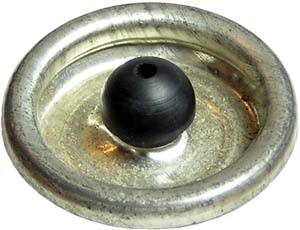
Hank Roberts LP Gas Canister
The old Optimus 702 and Hank Roberts LP Gas canisters for the the Gerry, Browning, Hank Roberts (Web Archive), and Optimus 731 Mousetrap stoves have a special rubber nipple that seals around the unique fuel needle used by these stoves. These canister are no longer made so you will need to refill these cans or find/make and adapter to allow your stove or lantern to run newer canister designs. See below for more on Hank Robert adapters.
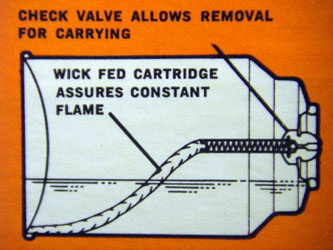
These canisters were one of the best designs ever made. The wick within the canister allows liquid fuel to be pushed out of the can even at low temperatures and with minimal gas pressure.
|
Brand |
Size Gm |
Fuel |
Fuel Oz |
Canister Oz |
Total Oz |
Fuel Gm |
Canister Gm |
Total Gm |
% Canister Weight |
|
Snow Peak |
110 |
I(65)/P(35) |
3.9 |
3.05 |
6.95 |
121 |
95 |
216 |
43.9 |
|
Snow Peak |
220 |
I(65)/P(35) |
|
|
13.05 |
|
|
406 |
45* |
|
MSR |
113 |
I(80)/P(20) |
4.05 |
4.05 |
8.10 |
126 |
126 |
252 |
50.0 |
|
MSR |
227 |
I(80)/P(20) |
8.00 |
4.65 |
12.65 |
249 |
144 |
393 |
36.6 |
|
Peak 1 |
97 |
B(70)/P(30) |
|
2.7* |
|
|
84* |
|
46* |
|
Peak 1 |
220 |
B(70)/P(30) |
7.85* |
5.40 |
13.25* |
244* |
168 |
421* |
40.8 |
|
Primus |
220 |
I(10)/B(70)/P(20) |
8.55 |
4.60 |
13.15 |
266 |
143 |
409 |
35.0 |
|
Primus |
450 |
I(10)/B(70)/P(20) |
|
|
22.65 |
|
|
704 |
36* |
|
Burton |
355 |
I(70)/P(30) |
|
|
|
|
|
|
|
|
Camping Gaz |
220 |
B(80)/P(20) |
8.75 |
4.60 |
13.35 |
272 |
143 |
415 |
34.5 |
|
Camping Gaz |
450 |
B(80)/P(20) |
|
|
22.95 |
|
|
714 |
37* |
|
Powermax |
170 |
B(60)/P(40) |
6.0 |
2.2 |
8.20 |
187 |
68 |
255 |
26.8 |
|
Powermax |
300 |
B(60)/P(40) |
11.1* |
2.8* |
13.90 |
346* |
86* |
432 |
19.9 |
|
Coleman |
465 |
P(100) |
|
|
31.05 |
|
|
966 |
52* |
|
Century |
468 |
P(100) |
|
|
33.05 |
|
|
1028 |
54* |
|
I - isobutane B - n-butane P - propane * unconfirmed source |
|||||||||
Related Links:
instructables Refill-Disposable-Propane-Tank-from-a-Standard-BBQ - 45% canister weight for Coleman propane canister
Carbon monoxide poisoning is a real world concern for backpackers and kill many outdoorsmen each year, including healthy experienced climbers. Please read more about the Dangers of Carbon Monoxide before considering using a stove in a tent.
| CO PPM | |||
| Stove | Simmer | Medium | High |
| Brunton Raptor | 88 | 286 | |
| Coleman Xtreme | 5 | 5 | |
| Coleman Fyrestorm Ti | 5 | 30 | |
| Coleman F1 Ultralight | 75 | 154 | |
| Jetboil GCS | 5 | 6 | 90 |
| Kovea Expedition | 6 | 12 | |
| Kovea Moonwalker | 30 | 50 | |
| MSR WindPro | 30 | 85 | |
| MSR Pocket Rocket | 240 | 220 | 140 |
| MSR Reactor | 300 | 50 | |
| Optimus Crux | 300 | 260 | |
| Optimus Stella + | 47 | 136 | |
| Primus Gravity MF | 10 | 100 | |
| Primus EtaPower EF | 3 | 8 | 13 |
| Primus Micron Ti 2.5 | 40 | 88 | 90 |
| Snow Peak GS(T) 100 | 5 | 21 | |
| Snow Peak GS200D | 260 | 130 | |
| Trekka/Gasmate | 120 | 100 | |
| Vargo Jet Ti | 30 | 12 | 22 |
"Stoves, Tents and Carbon Monoxide - Deadly or Not?Part 3: Laboratory Measurements for Canister Stoves," by Roger Caffin.
promountainsports.com winter-camping
tgomagazine.co.uk subject-primus-micron-ti-25
backpackinglight.com Stoves, Tents and Carbon Monoxide - Deadly or Not?
Not all stoves are created equal. Some canister stoves produce deadly levels of carbon monoxide at sea level, while others are considered somewhat "safe" to use in a ventilated enclosed area.
The measurements above range from 5 to 300 PPM. And while exposure of around 30-35 PPM in an eight hour period is considered "safe" at habitable altitudes, higher altitudes change everything. At higher altitudes, even exposure to low levels of CO become hazardous.
Most of the information below discusses ways to allow you to operate a stove in ways it may not have been designed for, such as allowing it to operate at low temperatures, in tents or with fuels and fuel canisters it wasn't designed or marketed for. Some of these practices are inherently dangerous, even when preformed by "experienced" backpackers and climbers in tip top health. Plus many, if not all, of the commercial items and stoves displayed, described or otherwise mentioned on this page are dangerous even when following the manufacture's recommendations. The operation of any LPG stove is basically a way to control the release and burn of highly explosive gasses which are trapped in a thin walled container filled with gasses that have been pressurized to the point they have become liquid. Everything is provided here for educational purposes only. Performing any of the techniques mentioned on this page or use of any equipment mentioned on this page is potentially dangerous. DO SO AT YOUR OWN RISK.
Liquefied Gas and Temperature
This is the most important caveat of using gas fuel that every backpacker needs to understand is that gas canister stove works because fuel trapped in canisters will boil off at room temperature and forces its way to your stove when you open the valve. As your stove uses up gas from your stove, the canister must vaporize more fuel to take the place of gas traveling to the stove. Vaporization of fuel requires energy, so the temperature of the remaining fuel drops. If you hold the canister in your hand while it is being used, you can feel it getting cold. If the temperature of your fuel drops below a certain point it will cease to vaporize more fuel and your stove will stop working. If your fuel is below its boiling point, your stove won't start. If your fuel is near but above its boiling point, it will start and then sputter out unless you can kept the fuel "warm".
See The Nature and Behaviour of Mixtures of Fuels by Roger Caffin for more information on gas dynamics.
Air Pressure vs Temperature of Fuel
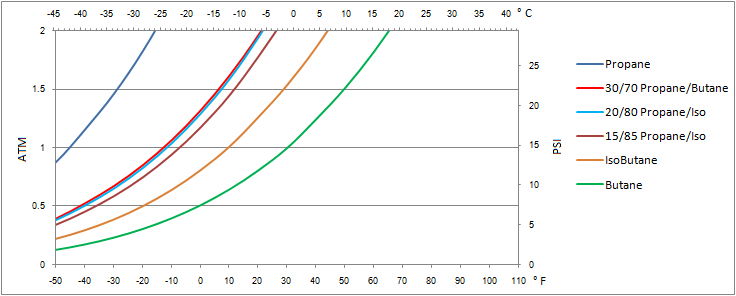
The boiling point of each of these gases is around the 1 ATM level at sea level and decreases as you climb in altitude
Fuel Boiling Points vs Altitude
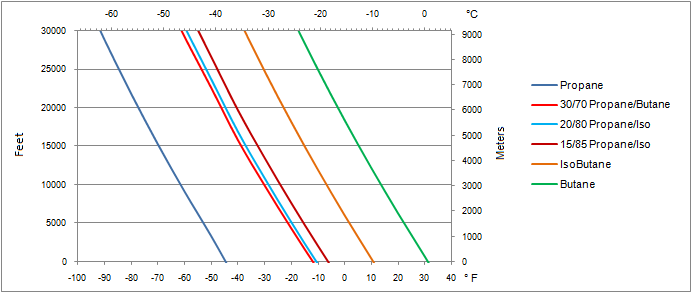
Graph Link h = ((P0/P)1/5.257-1)(T)/0.0065
At sea level:
Propane boils around -43° F (-40° C)
Butane boiling around 31° F (-0.5° C)
Isobutane boils around 11° F (-12° C)
Using the Right Gas
One way to improve performance of a butane stove is to use a mix of fuels with low boiling points. Pure propane is the best commonly used liquefied gas for cold weather but requires a heavy duty steel canister which isn't suitable for most types of backpacking. Butane can be stored in much thinner walled cans, making it better suited for backpacking in regards to weight but butane doesn't work near freezing temperatures. Often isobutane and/or propane are added to butane canisters to allow the stove to get started in subfreezing temperatures. Unfortunately, in very low temperatures, the propane and/or isobutane will boil off first in an upright canister and leave the majority of the butane fuel unusable at those temperatures.
Fuel Insulation and Platforms
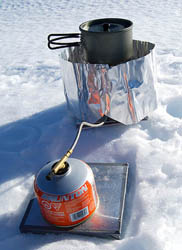
When faced with subfreezing temperatures, you need to protect your canister from further cooling. You may want to set your fuel on an insulating platform to protect it from the cooling effects of snow, ice and cold rock or dirt.
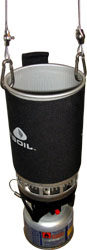
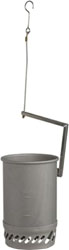
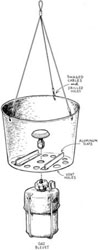
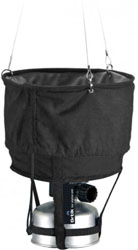
Suspended/Hanging Stoves
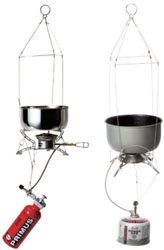
Primus Stove Suspension Kits
Some climbers use hangers to suspend their stoves and pots so they can melt snow without melting their snow floors and freezing up their fuel. Suspended stoves also allow you to stretch out your legs under your stove while still in your sleeping bags. And although suspended stoves are used by many experienced, and not so experienced, climbers and mariners in confined spaces, it is important to note the dangers of running a stove in a tent, cave, igloo or other small enclosed space.
 |
 |
|
|
ETA Hanger |
Dangers of using stove in tent or other enclosed area:
Carbon Monoxide Poisoning - read about this and take heed. It's an odorless hazard which insidiously takes your senses, killing many each year.
Flare-ups can and have set tents, sleeping bags and people on fire. Burns are horrible and disfiguring. Canister stoves may flare up less so than other stoves, but they can still ignite any highly flammable synthetic backpacking equipment that gets too close to it. This includes your jacket you are wearing or sleeping bag you are trapped in.
Spills - anything that hangs can come down for multiple reasons. Some hanging pot setups are just tipsy as is and can flip over with little provocation. Burns from hot beverages or food are dangerous and will leave you wet and cold after burning you.
Related Links:
The MSR Reactor and the Jetboil Personal Cooking System
tonysbushwalking.wordpress.com/ hanging-stove-project
nonplatonic.com hanging_stove_of_espresso_goodness
mountainvisions.blogspot hanging-stove-system-why-it-is-superior
Ortik - cloth hanging system
Size Maters
Larger fuel canisters absorb heat loss better than mini canisters and will last a little longer before your stove sputters out. So, one big canister is better than two small ones.
Running your stove at full blast will also create much faster vaporization of fuel than running your stove at a simmer, therefore cooling your canister off faster. So, one should avoid running a stove at a higher setting than what is really needed.
Canister and Fuel Warming
Keeping your canisters warm is the key to canister stove function in the cold. There are a number of ways to do this. Some are safe, while others are down right dangerous if done inappropriately or if luck is not with you.
Safe methods of warming fuel canisters
keep it in your jacket to warm it up
sleep with it in your bag
place or dip it in warm or even cool water (NOT HOT). See seattlebackpackersmagazine.com stoves-for-cold-weather
urinate on your stove - not recommended for general use in a tent
chemical hand-warmers may help a little
after warming, use cozy to insulate canister. See wordpress.com what-to-pack-for-winter-backpacking-part-2
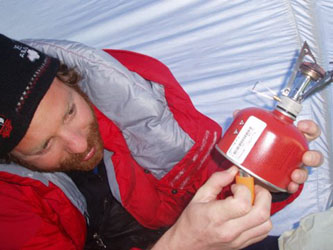
Risky methods of warming fuel canisters - using heat from a stove - overzealousness and carelessness can lead to an explosion - Consider the following at your own risk
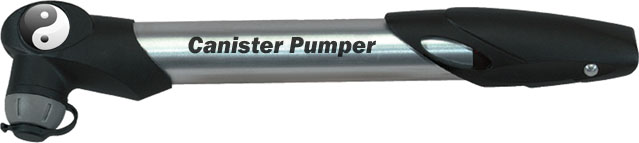
If your are using your canister inverted, you can use a small bicycle tire pump to pressurize your canister. This will pressurize it enough to force out enough liquid fuel to get your stove going. You will then need to use that heat wisely.
pour a small amount of hot water on your canister
use a carefully ventilated windscreen to trap heat around your canister. If you do too good of a job insulating the canister, it can explode.
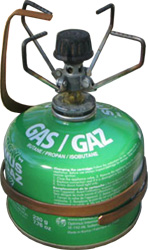
use a heat exchanger (flattened copper wire with one end wrapped around the canister once and with the other end protruding up into or near the flame).
Prepaint canister black, place in plastic bag and leave out in sun. This will only work during daylight hours and if overdone on a summer day or for too long, can lead to an explosion.
Related Links:
iceclimbingforums.com 7679-Heat-exchanger-for-MSR-Reactor
video.google 3717016644346348598 Heat exchanger on remove canister stove
warm a canister by placing it near your running stove (too close for too long and you might end up dead or without one of your hands)
Candle heat exchanger. See picasaweb.google.com Zelfbouw1 and picasaweb.google.com Zelfbouw2
Very wide pans are on the list of things to avoid because heat reflected back and overheat a gas canister. This could be used intentionally with monitoring to keep your fuel warm.
Note - most canisters made for gas stoves are designed with a concave bottom that will pop outwards before complete canister rupture if over pressurized. The valves themselves may also bleed off overly pressurized gasses unless a stove or lantern is securely attached to it. Depending on either of these protecting you in the field can prove deadly.
DANGEROUS methods of fuel warming. When faced with actually freezing to death, you still have some potentially lethal methods for getting frozen fuel working. - Consider the following at your own risk in a LIFE or DEATH death situation when the alternative is certain death:
Heat canister by placing it directly in a flame. Do NOT place a hose from your canister or the top of your canister in flame. If all of your canisters are frozen, use a candle, alcohol in a can (or bottom of a canister), ESBIT, warm lighter or kerosene soaked in something to heat up a canister and your fingers (so they get warm - not cooked). Warning - placing a fuel canister near or on a flame is dangerous.
cascadeclimbers.com Post850779
Puncture canister and use liquid fuel to heat up an non-punctured fuel canister. This can easily lead to an explosion. Make sure punctured canister is far away when you light the liquid fuel. Cover all skin and hide behind pack. Warning - this is REALLY DANGEROUS.
Make small puncture in canister to allow for air to enter and raise canister above remote stove to allow the liquid fuel to gravity feed. Use thumb to seal hole once you are done with it and place it far far away. If you really are going to die, you can place a plastic bag (ziplock or trash bag) with a small hole in it over the puncture. This plastic will help prevent your lips from freezing to the canister. Now blow and try not to inhale when your mouth is on the canister. You'll wish you had a rubber hose to blow in...or an tire pump...or a petrol stove...or were on a tropical beach. Warning - this is REALLY DANGEROUS.
Use a tire pump to pressurize your intact gas canister before mounting stove. Flip upside down, light and allow heat from your flame to warm up that or another canister before flipping it over. Depending on stove design, you may be able to use your mouth to pressurize a canister by blowing into the jet with the canister upright and the valve completely open. Close valve after you've given it all you have and reassemble your stove. Warning - this is REALLY DANGEROUS.
What is too hot? The magic number seems to be around 50-52° C or 122-125° F, depending on which hazardous materials guideline you are following. But it is unclear how extreme cold, potential dents in your canisters from storage and decreased air pressures from altitude, warm tent air and general bad luck will affect the strength of your canister and its resistant to exploding.
| Subjective Temp | Temperature |
| Tissue Damage | 120° F (48° C) |
| Too Hot to Touch | 107° F (42° C) |
| Hot | 90-100° F (32-37° C) |
| Warm | 80-85° F (26-29° C) |
| Tepid | 72-76° F (22-24° C) |
| Cool to Touch | 50-65° F (10-18° C) |
| Cold | 32-40° F (0-4° C) |
Basically, your canister can be cool and still operate just fine. If it gets warm, you are overdoing whatever you are doing. If your canister is hot, you need to shut down your stove and/or stop whatever you are doing that is heating up your fuel and evacuate the area. And if any of this information has convinced you that heating up a thin metal canister filled with highly pressurized explosive gasses is safe, gather your thoughts, reconsider and keep in mind that there are good reasons why all of your friends think this may be dangerous. Again - this information is for educations purposes only and not a recommendation to proceed with practices which are potentially dangerous.
Canister Feed Tube/Wick
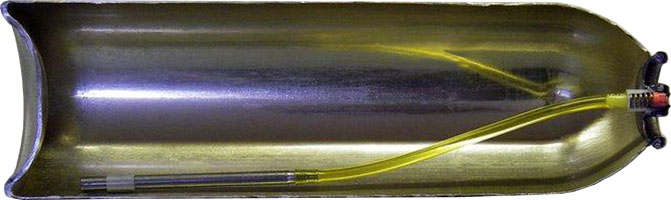
Coleman PowerMax Canister - Note the weighted inner Feed Tube
Another method to maximize fuel pressures is to feed your stove liquid instead of gas fuel. This concept is used with the Coleman PowerMax and few other discontinued fuel canisters. These special canisters have a wick or diptube to pick up the liquid fuel at the bottom of the canister instead of the vaporized gas fuel at the top. This allows the vapor pressure of more volatile gasses such as propane and isobutane to force mixed liquid fuel into your stove. This is a big deal when you compare this to a conventional burner over canister stove setup, where more volatile gasses are vaporized and used disproportionately early on, you with a canister of cold and unusable butane. Plus, tapping into the liquid instead of vaporized fuel results in less phase change from liquid to gas in the canister which in turn means less canister cooling when using fuel.
The Hank Roberts canisters also had a similar "wick" in their canisters to allow for liquid feeding of fuel.
Unfortunately, the PowerMax and Hanks Roberts canisters are no longer made. You may be able to find some hidden away in a surplus store or on Ebay. And it is possible to refill these if you really want the best canisters ever made. See the refilling section below for more information on refilling canisters. The PowerMax canisters were particularly useful as they were made from aluminum and had a high propane to butane ratio compared to other mixed fuels.
Related Links:
Inverted Canisters
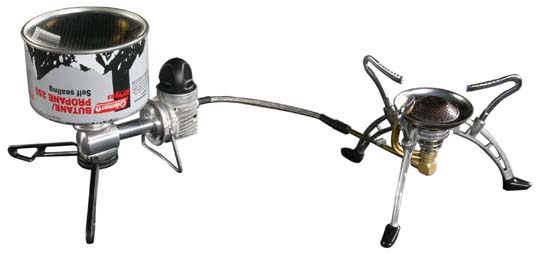
Coleman® Exponent® Powermax® Fuel Adapter New Link
Getting liquid fuel from a canister to your stove can also be accomplished by flipping a canister upside down on a remote feed stove. This feeds your stove with liquid fuel instead of vaporized gas fuel. This does basically the same thing as using and inner feed tube on the Coleman PowerMax canisters, but without the need of any special canisters. Coleman in fact made an adapter to run Lindal screw on canisters upside down.
The Primus Himalaya manual states that one safe cold environment trick is to:
"Turn down the control valve as low as possible. Now hold the gas cartridge and turn it upside down slowly and very carefully. While doing so, you must never lift the cartridge higher than the stove itself to avoid a sudden burst of flames."
When asked (a long time ago) via email if the MSR Windpro could operate with the canister upside down, a tech at MSR replied:
"Yes, you can turn the canister upside down when using the WindPro but you would want to use the same precautions stated in the Primus manual."
MSR and all the other major stove manufacturers have since developed and marketed stoves designed to use inverted canisters.
Since the Primus Himalaya EasyFuel, MSR WindPro, MSR Rapidfire, and Snowpeak GigaPower BF Stove [GS-300A] have hose connections for remote attachment to a fuel canister and have heated generator tubes, they should be able to run PowerMax canisters (you may need an adapter) or regular fuel canisters upside down. This technique was unknown to most outdoor adventurers at the original publications of this web page and was considered "dangerous" by many. Currently, the big stove manufactures have all designed and marketed high end stoves with inverted remote feed canisters.
There are several remote fueled canister stoves, such as the Markill Spider, that don't have vaporizer tubes (generators). This missing feature is required to vaporize liquid fuel prior to it exiting the jet. Running a canister upside down in a stove without a vaporizer tube isn't recommended and can be dangerous, leading to sporadic flareups. Flare ups can set your tent, gear or you on fire, causing severe burns.
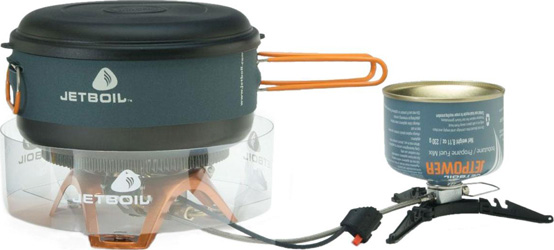
Now a days, there are several commercial and DIY options are available which allow you to invert a gas canister to allow for liquid fuel to flow to your stove.
NOTE: Running a canister upside down is like running your gas tank empty in that you will get whatever is in the bottom of the tank in your fuel line. There is a small amount of gunk in fuel canisters and they can clog your stove. This means that you will need to carry a wrench and extra o-rings with you if stove operation is critical in the field.
Related Links:
bushwalking.org.au FAQ_GasStoves.htm
alanrayneroutdoors.blogspot lightweight-gas-cylinder-inverter DIY plastic stand from Hot Pots
thunderinthenight.blogspot. inverting-spider
backpackinglight.com 479212 Canister inverted leaning against foam pad
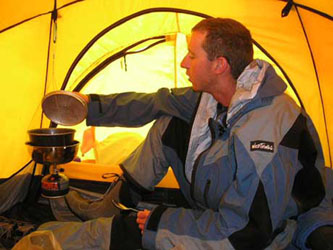
Altitude affects stove operation and cooking in some odd ways. As you climb in altitude, the boiling point of fuel and water decrease as atmospheric pressure decreases. Higher altitudes actually allow gas stoves to operate at lower temperatures, but increase cook times as boiling water isn't as hot as it is at sea level. It is generally colder at higher altitudes, which will have a detrimental effect on stove performance. There is also less oxygen at higher altitudes where you may notice more of a yellow flame suggesting and incomplete burn of your fuel.
Air Pressure vs Altitude
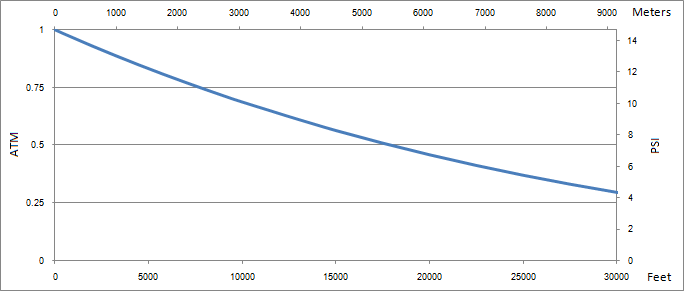
Fuel Boiling Points vs Altitude
Graph Link h = ((P0/P)1/5.257-1)(T)/0.0065
Here is a graph created from published Antoine Equation Parameters and a crude barometric pressure to altitude calculator. So it's a really rough guide and does not take into account humidity, wind, low oxygen levels (low at altitude and even lower in a tent or cave) and a myriad of real life factors which would make stove operation at - 90° F unlikely.
Related Links:
equipped.org 215951 P3 Elevation_vs_Boiling-Point_Chart.gif
hyperphysics.phy-astr.gsu.edu/hbase/kinetic/barfor
hochwarth.com/misc/AviationCalculator
Another limitation of canister stoves is that they may have problems staying lit in the wind. An easy way enhance their performance is to simply add some sort of windscreen. A windscreen not only protects the stove flame from wind, it also insulates heat around your pot to maximize efficiency. Unfortunately, windscreens can be dangerous for canister stoves as the heat they trap around the stove and heat up a canister which can in turn lead to an explosion.
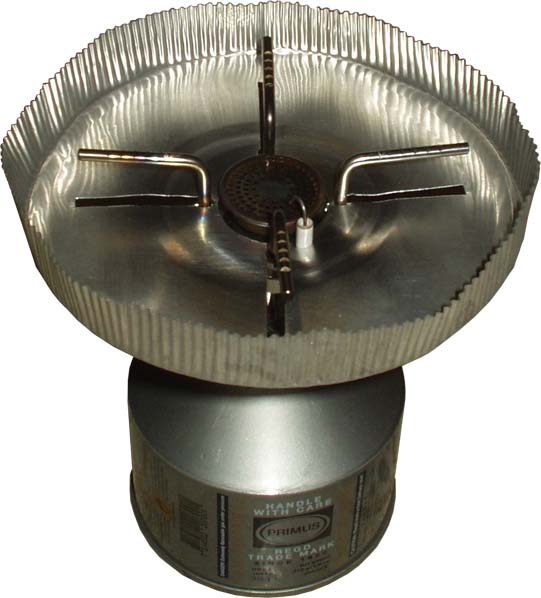
Pie Pan Windscreen Base
If you decide to build a windscreen, one potentially safe option is to build system with a reflective base for the screen between the stove and canister, like the one shown above. Then mount your vertical windscreen above this so that it doesn't surround the canister. These can be easily built from coffee cans, pots larger than the one you are using to cook with, oven liners, aluminum flashing, etc. See our Zen Windscreens Page for more on this.
The crimped edge of the windscreen show above were made with a homemade crimper. See Special Tools.
Another option is to build a windscreen that doesn't go completely around the stove but instead leaves a large enough opening to prevent any build up of heat around the canister. This
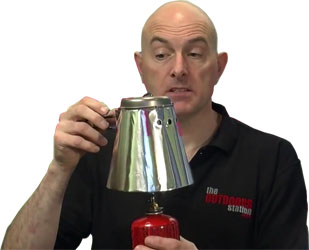
Cone Shaped windcsreen attached to top of pot
Related Links:
Roger Caffin's Wind and Radiation shields
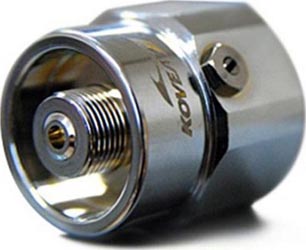
Allowing for LPG steel cylinder propane canisters to be used with light weight camp stoves designed for butane can have some significant advantages. For one, the propane will allow you to cook or melt snow at much lower temperatures than with butane. Propane is generally much easier to find and also much cheaper than butane. And if you are handy, you can easily refill the portable propane canisters from larger propane tanks with a small adapter. This allows you to carry exactly the amount of fuel you'll need for a trip and allow for some really affordable fuel. The Kovea adapter shown above is pretty hefty. See adventuresinstoving.blogspot.com propane-for-backpacking-ii.
If you choose to run pure propane in a stove made for butane,
keep in mind that propane produces about quadruple the vapor pressure that
butane does. This increase in gas pressure may exceed what a given
butane stove is designed to handle. This can be fun and/or
devastating, depending on what you are looking for, especially on hot
summer days.
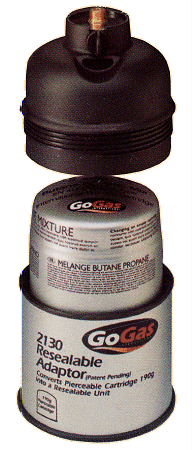
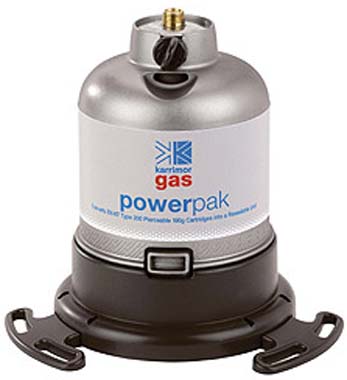
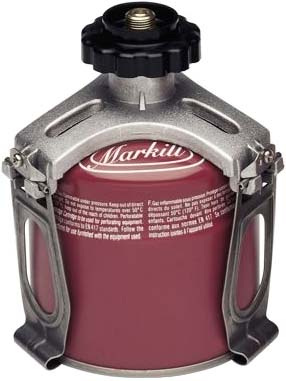
9.7oz GoGas, 8.25oz Powerpak and 6.3oz Markill Pierceable gas cartridge adapters
Adapters such as the GOGAS 2130, Karrimor PowerPack and Markill's (each show above) allow you to use pierceable fuel canisters with EN 521 stoves and lanterns designed for fuel canisters with 7/16 NS threaded Lindal valves .
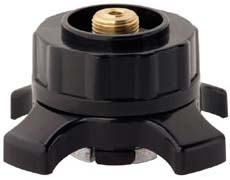
Markill Campingaz Adapter
Markill makes an adapter for the Campingaz CV line that may also work with the PowerMax canisters. Just beware that if you use the PowerMax canister, fuel will come out in liquid form, which may be dangerous depending on the design of your stove.
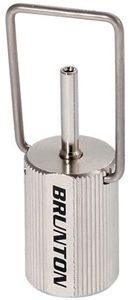
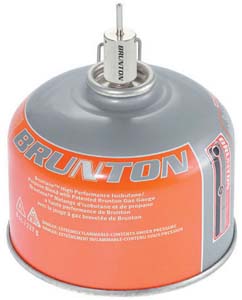
0.9oz Brunton FuelTool
Resealable screw on canisters can be converted to a male universal fueling tip canister with a FuelTool which may offer you the option of refilling lighters and lanterns on the trail and/or use special mixes of fuels for to improve cold weather reliability. Primus has a "Butane Fuel Tool" and Soto has what looks like the same adapter as Brunton.
These adapters can also be used for custom DIY stove projects where you need a fitting that can attach to a fuel canister. You can also use epoxy or other means to attach a barb for a hose to this adapter and to lock the nozzle open. You can also graft on other valves to make your own custom adapter. One example would be to epoxy on a cut down tire valve stem to allow for pressurization of the canister with a tire pump or to allow for economical attachment to a canister for a crazy DIY project.
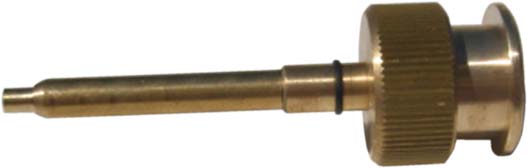
Cheddar Gas Refill Adaptor
A very similar brass adapter may be found through a model train store for refilling trains with screw on canisters. GasMate has yet another adapter. This one is designed to allow bayonet canisters to be used for refilling lighters and the like.
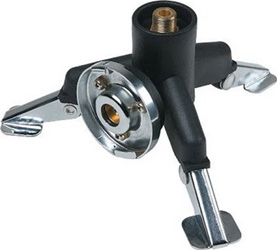
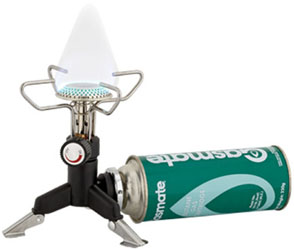
Gasmate makes an adapter to allow for canister mounted screw on stoves to use side mounted Butane canisters with bayonet connections (such as the gasmate G4210 or B-CAN2) . These cans have a notched rim to allow you to twist and lock them in place.
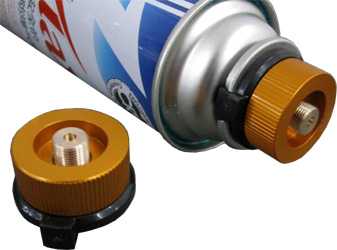
adventuresinstoving.blogspot butane-adapters-ii - "These adapters are shoddy junk"
plus2city.com Transfer Connector
aliexpress.com gas-adapter-COPPER-MATERIAL
KOVEA Adapter for Butane Nozzle Type Gas stove KA-N9504
CE-020 Adapter Nozzle Gas Bottle Screw
LT -01 Adapter Nozzle Gas Bottle Screw
Hank Roberts Stove Adapters:
Spiritburner.com 1589 Requires login?
Hank Roberts Conversion Complete
Spiritburner.com 17866 Requires login?
oregonphotos.com Gerry - Discussion on adapter by Henrik M
adventuresinstoving.blogspot.com hank-roberts-mini-stove-mark-iii
spiritburner.com 14437 - discussion on refilling
Camp Pro (Web Archive) offered a RetroFit Kit (Web Archive) for the old Hank Roberts, Camp Pro and Perfection camping Mini Mark II & III, Gerry Mini, & Browning Mini needle style stoves that enables them to use the newer threaded style canisters.
If you don't see the adapter you need above, you can purchase just about any kind of adapter from www.alva.ne.jp Babel Fish and tumekaekun.com.
It is important for those who are serious about weight to be able to determine how much fuel they will need and how much is left in canisters. Since LPG canisters aren't transparent, it can be difficult to determine how much fuel you've used and how much is left. But, with a little practice, you should be able to shake a used canister and estimate how much is left (don't shake it while your stove is running). You can also look for a condensation or frost line on your canister while using it.
Probably the most accurate way of determining fuel left in a canister is by weighing it. This may not be an option on the trail, but after you get back, you can weigh your used canisters to determine how much fuel was used on your trip. Record full and empty weights of your canisters for future planning purposes, and write the amount of fuel remaining on the side of the canisters after each trip. This will help you later determine which cans to take on a trip.
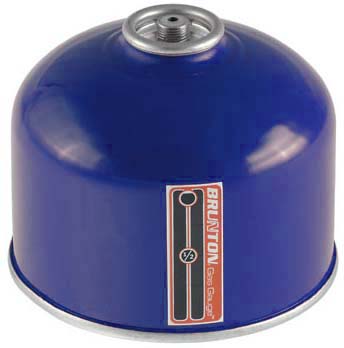
Brunton Gas Gauge
Burnton makes a sticker similar to a aquarium thermometer sticker for measuring fuel in your canister.
You can float a canister upside down to estimate how much fuel remains in it. See jjmatheshikes.blogspot how-much-fuel-is-in-that-canister and outdoorquest.blogspot gas-stove-fuel-is-canister-full.html
Disposal of Canisters
So, what do you do with the canisters after you use up every last bit of fuel? One option is to refill them (described below), and the other is to recycle them or to throw them out.
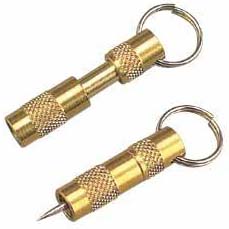
Snow Peak Can Puncher
Disposal of empty fuel canisters poses a problem as even when empty, they can explode when crushed by a trash compactor. In order to safely recycle or dispose of empty canisters, they should first be punctured. Puncturing may be done with a commercial grade Can Puncturer, a mini Can Puncher such as those made by Snow Peak and Coleman, or any assortment of chisel/hammer combinations. Cans not punctured are considered hazardous waste and should be disposed of at at a Universal Waste Handlers.
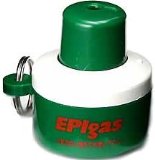
EPIカンベンチレーター (EPIgas Can-Ventilator)
Is puncturing your canister safe to do? Most manufactures state on their canisters to never puncture/pierce or incinerate, even after use. That said, lots of people puncture and crush canisters in their garages, and it probably isn't as risky as you think, as long as the canister is empty. A hammer and chisel seem to be popular method, but this isn't recommended because of the spark potential and more importantly - it will ruin a good chisel. But that's ok, because if you don't have one of the fancy tools shown here, make sure the can is empty and use a basic "church key" can opener to vent things. Do so at your own risk.
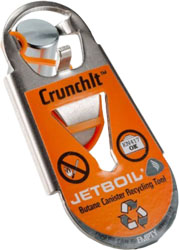
Can you just throw away empty canisters? This depends on where you live and who you talk to. Some areas allow you to throw out empty canisters (including disposable propane canisters) if they are under two pounds or so. Other areas will require that canister can only be disposed of at a special disposal facility. And regardless of local codes, these are more or less safe to recycle once vented.
hikernerd.blogspot.com disposing-and-recycling-stove-canisters
outdoors.webshots.com 556372763fTgNJn
Being able to refill your fuel canisters gives you the the option to custom adjust the amount of fuel for a trip, consolidate fuel from partially empty canisters, and use cheaper fuel (especially in the case of propane to propane filling). And in some parts of the world, this allows you to refill expensive and hard to find canisters with gas from cheap and easy to find ones. Unfortunately, liquefied gas canisters used for backpacking are generally considered nonrefillable. Butane canisters are generally too thin to "safely" reuse over and over again and lack bleeder/dump valves. The heavier steel cylinders used for propane canisters are considered unrefillable by the manufactures and possibly by law (for resale). That said, if it is possible to refill plastic butane lighters, it is likewise possible to refill metal butane and propane canisters - the real question is whether it is safe or not. The following information is for educational purposes only and in no way can refilling canisters marked "Never refill this cylinder," "Do Not refill," etc be considered completely safe. Do so at your own risk.
Consequence of Over-filling
A properly filled canister must have an "air pocket" to allow for fuel expansion. This is because gasses can compress, while liquids don't compress well. If a canister is over-filled, then the expansion of the liquid as the temperature increases may cause the cylinder to become “liquid-full”, i.e. with no remaining ullage space. If the temperature continues to rise, the pressure in the cylinder will rise disproportionally. If there is no safety relief valve, or it fails to operate, the cylinder may burst after only a small rise in temperature.
Propane Canisters
Heavy duty propane canisters such as those sold by Coleman seem well suited and even designed for refilling. They can be easily and very cheaply (1/6 cost of replacement canister) refilled from larger canisters with a brass coupler (show below) or with a fabricated homemade adapter. The key is to not overfill the canister, as that would guarantee a leak after it warms up.
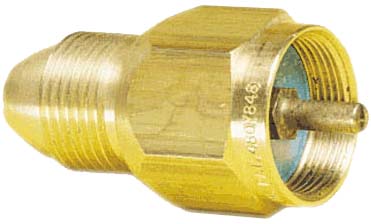
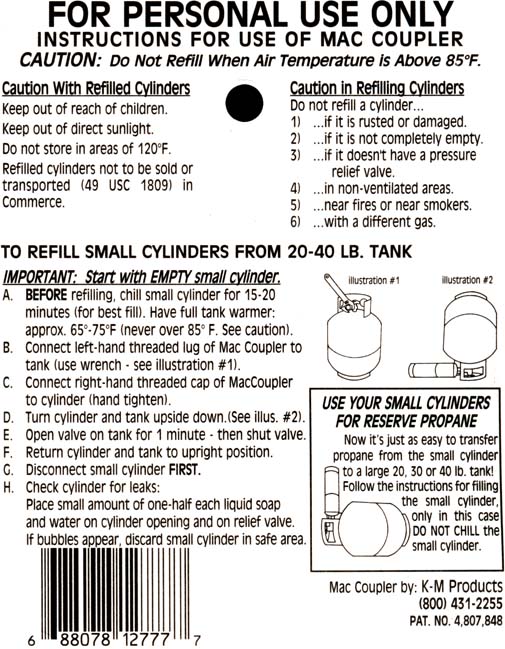
To ease filling you may need to stick your cylinder in a freezer for half and hour or more to liquefy your fuel and decrease pressure in the canister.
To help avoid overfilling, you can fill the canister while it is at an angle so that air/gas is trapped in the top most portion of the canister. The trapped gas will prevent the cylinder from overfilling. You can also use the bleeder valve to dump any extra fuel. You can also record the full weight of a new canister, weigh your canister after fueling and add/dump as needed. Shake your canister when you are all done to make sure that it isn't "topped off."
Butane Canisters
These canisters can be very thin and are not made for long term abuse. If you are trying to save money by using fuel not made for your stove, there are easier and less problematic options, such as using an adapter that allows your stove to run cheaper fuels. Also see this Bushwalking Stove site for more information on refilling.
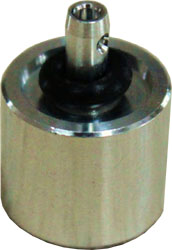
This gas-refill-adapter allows you to use economical bayonet gas canisters to refill your Lindal and Campingaz canisters with ease.
Related Links:
taiwancamping.net gas-refill-adapter
outdoorkopitiam.blogspot mountaineering-gas-refill-adapter
outdoorkopitiam.blogspot snow-peak-gigapower-fuel-110-isopro
urbanusmagnus.blogspot gear-review-butane-canister-refill-tool
A Burton FuelTool or butane canister designed for refilling lighters can be used to refill Campingaz and PowerMax canisters. You need to get creative with a seal to limit gas leakage during the process. See spiritburner.com 18031
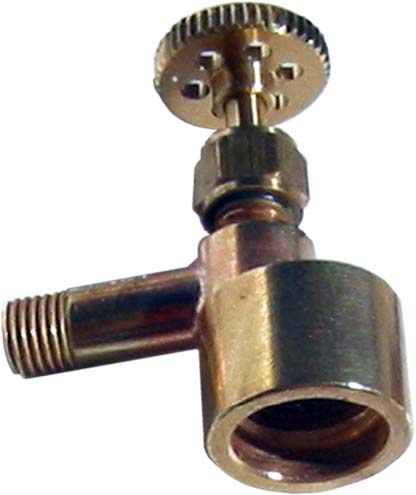
Cheddar Gas Valve designed for refilling tanks for model trains
Two of these with a hose or tube connecting them should make a great refill tube
An adapter can be easily fabricated from two Brunton FuelTools, old stove parts, couplings, etc. Or, just about any combination of adapter can be purchased from www.alva.ne.jp Babel Fish.
To help avoid overfilling, you can try filling the canister while it is at an angle so that gas is trapped in the top most portion of the canister. The trapped gas will prevent the cylinder from overfilling. You can also record the full weight of a new canister, weigh your canister after fueling and add/dump as needed. Shake your canister when you are all done to make sure that it isn't "topped off."
Running Propane in Butane Stoves
On a warm day, propane will produce a significant amount of pressure compared to butane. Some feel that you may need to add a pressure regulator to prevent damage to your stove if you decide to hook a butane stove to a purely propane canister. Some propane to butane adapters are designed with a pressure limiter to limit propane pressure outflow. If you don't run a pressure regulator, you will need to start with a very low stove setting and carefully adjust your gas flow expecting your adjustments to be much more sensitive.
Vapor Pressure of Propane, Isobutane and Butane
Filling Propane in Butane Canister
DO NOT DO THIS.
Filling a light duty butane canister with 100% propane is easy to do and may seem to give you the best lightweight cold weather cook system around, but the thin walled canisters designed for butane are not designed to handle the propane pressures as the temperature rises. Just look at the graph above and note the difference between the partial pressure of propane vs butane at 110ºF. The the potential pressure of propane just keeps going up as the temperature rises, making for a potentially unwanted event if your over pressurized canister is sitting in the back of your car on a sunny day, in your black backpack on a hot day or if you get any thermal feedback from your stove on a warm day. This build up of pressure can result in an explosion and even death. There is also a concern that refilling with propane may introduce water and other corrosive agents which will damage and weaken your canister.
It is possible to make your own mix of Propane and Butane. You would have to carefully weigh your canister before and after and make sure you don't exceed the safe limit of propane mixed with your butane. And as much fun as this may seem, even I would avoid messing around with this as failure could have catastrophic consequences - like exploding in your pack while it's on your back. Commercial mixes really aren't that expensive, and if they are - see our Alcohol Stove section of this site for more economical stove options.
Running Other Gases
Some gasses, such as acetylene, require a stabilizer to prevent violent decomposition and explosion during storage and transport. Hotter burning gasses tend to burn at higher temperatures close to the stove and may damage them or cause a serious incident. Use of gasses other than butane, isobutane or propane for refilling empty canisters, camp stoves and/or lanterns present a serious and real danger. Do not use fuels your stove or canisters are not designed for!
Related Links:
spiritburner.com 12606 Post109460
adventuresinstoving.blogspot.com gas-canister-refilling.html